Guides
Pokemon Card Collecting Guide 2026: Condition to Grading
Pokemon card collecting guide for 2026. Judge condition with TCGplayer's points, check fakes, weigh grading fees from $17 and store cards safely.
This Pokemon card collecting guide covers the four things that decide what your cards are worth to you and to a buyer: whether they are real, what condition they are in, whether grading pays, and how you store them. Each part links to a full guide, and every number below comes from an official page or a cited source, checked October 9, 2026.
TL;DR: Check a card is real first (the back's shade of blue catches most fakes). Judge condition with TCGplayer's points: Near Mint allows 3, Lightly Played 6, Moderately Played 12, Heavily Played 24. Grading starts at $17 (CGC Bulk, 25 cards) or $59.99 (PSA Standard), so it only pays on valuable cards. Store cards sleeved, flat, dry and out of the sun.
Pokemon card collecting guide: where to start (quick answer)
Start with a goal and four habits. Decide whether you are chasing a set, a Pokémon or a few specific cards, because that decides whether you open packs or buy singles. Then: confirm each card is real, judge its condition with a published standard, grade only when the fee is small next to the card's value, and store cards so they stay in the condition you paid for.
Key Takeaways
- Fakes first: compare against the official scan; the back's blue is the most common giveaway.
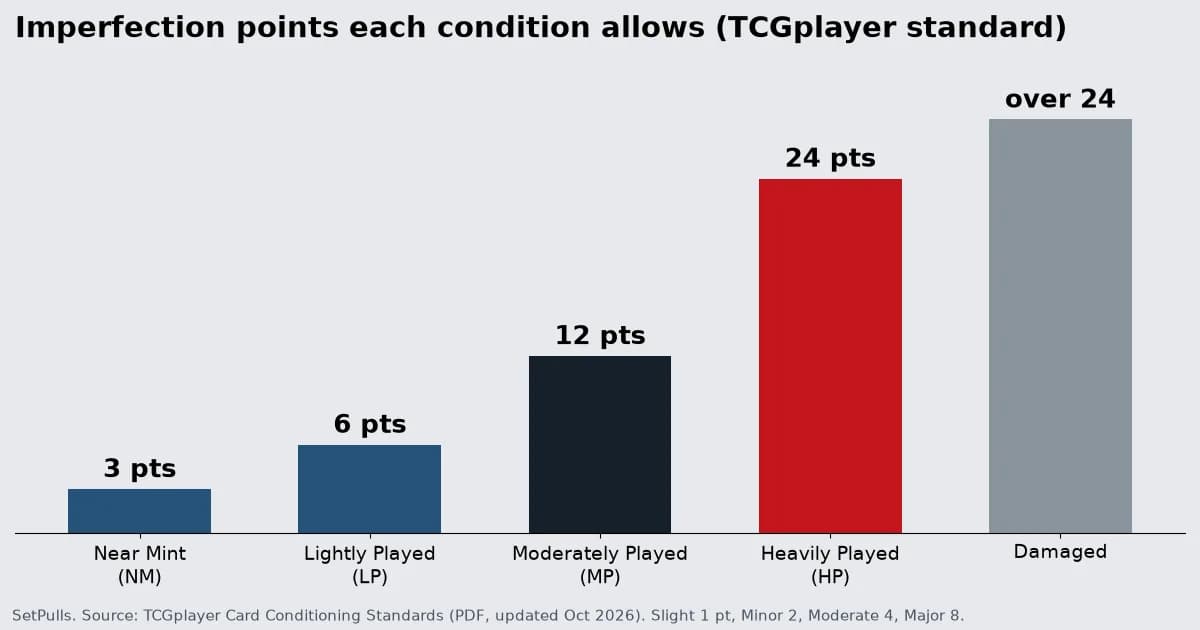
- Condition is points, not opinion: NM 3, LP 6, MP 12, HP 24 under TCGplayer's standard.
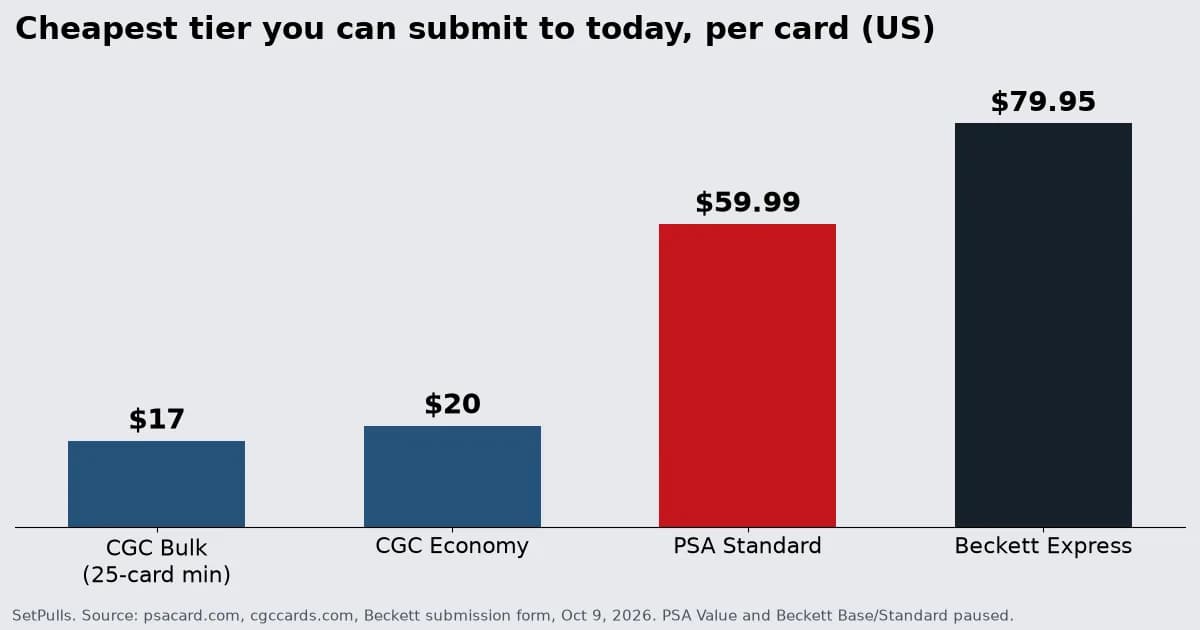
- Grading is a cost decision: CGC from $17 or $20, PSA from $59.99, Beckett Express only at $79.95.
- Storage protects value: sun, liquid, curl and binder gloss all count against condition.
- Prices are snapshots: Pokémon does not track card values, so always note the date.
Overview: how collecting works in 2026
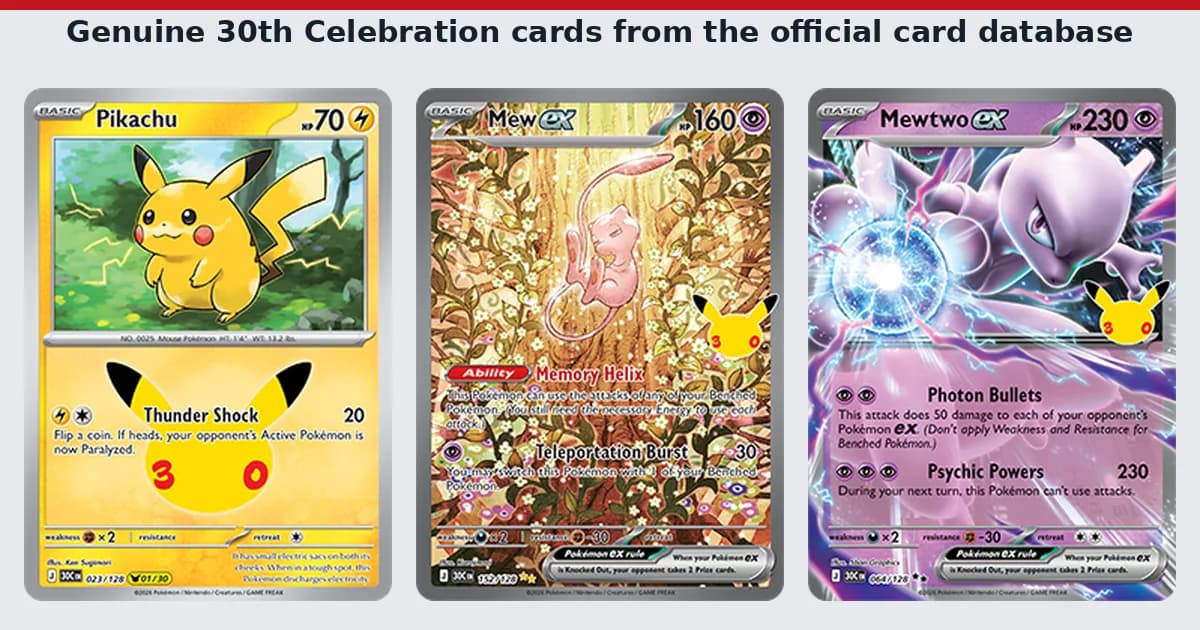
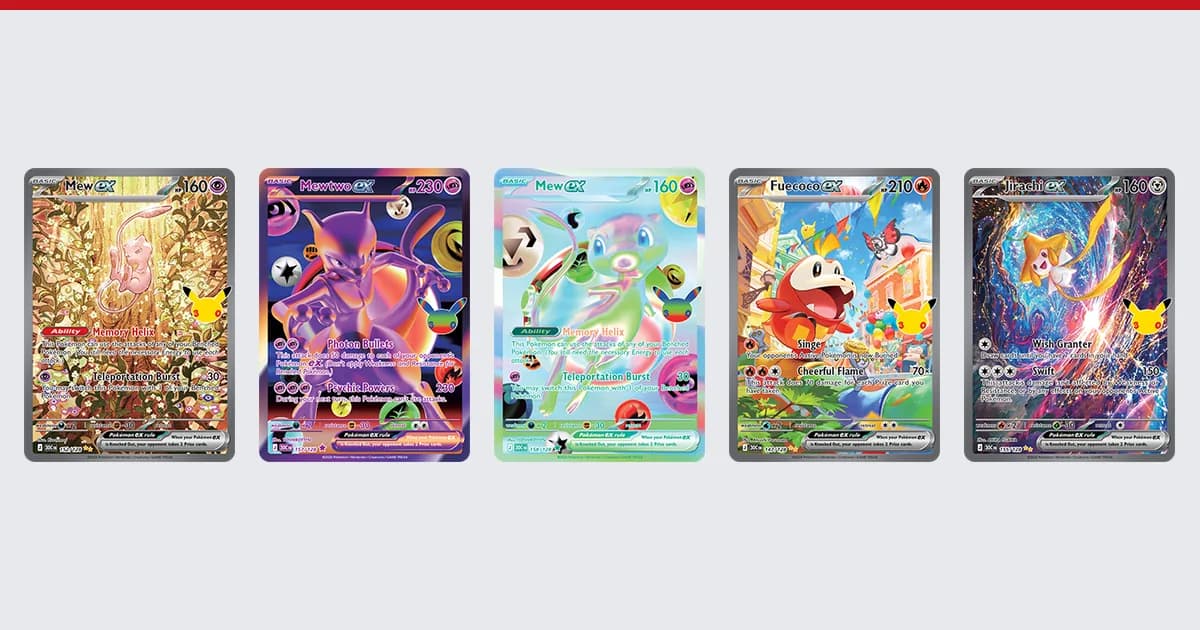
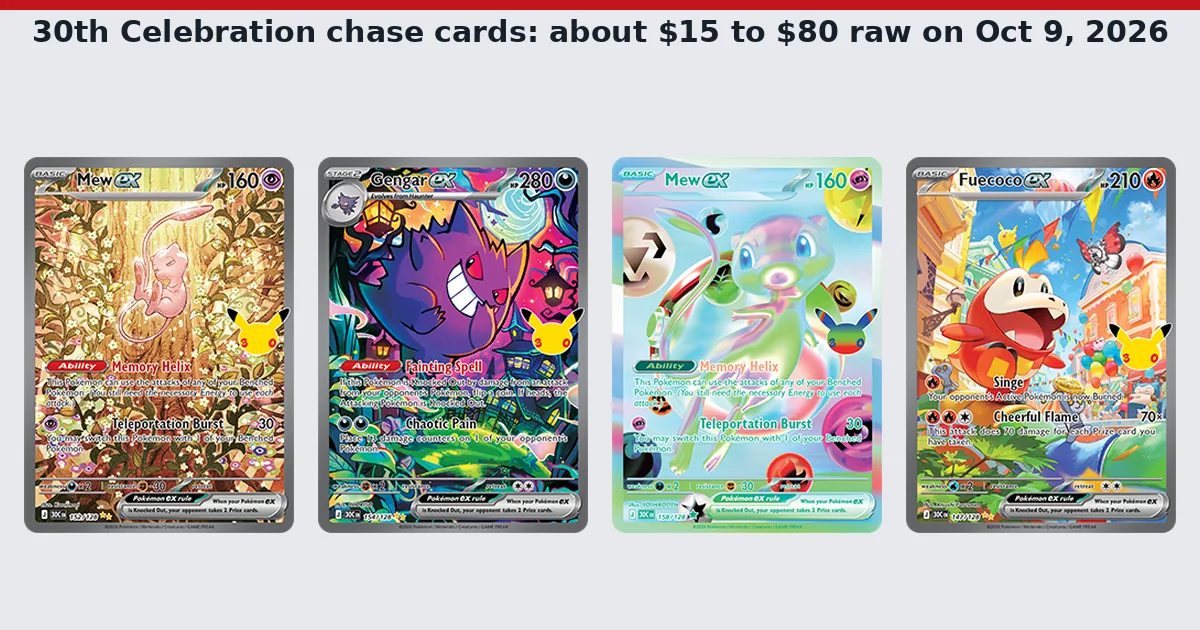 Card image: pokemon.com card database, arranged by SetPulls
Collecting Pokémon cards is two hobbies stacked together. One is opening packs and filling binders. The other is buying, selling and sometimes grading individual cards, where small differences in condition and authenticity turn into real money.
Once a card is in your hands, four questions decide what happens next, in this order:
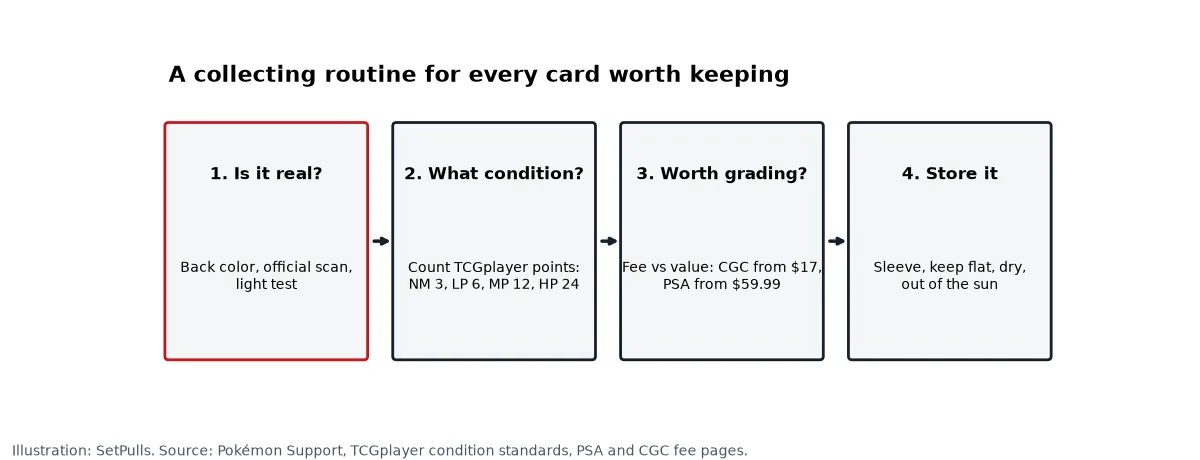 Illustration: SetPulls. Source: Pokémon Support, TCGplayer condition standards, PSA and CGC fee pages
The sections below take each step in turn and point to the detailed guide for it.
Packs or singles: the first collecting decision
Packs are the fun part of the hobby, and in the current English set they hit often. In TCGplayer's sample of more than 3,000 30th Celebration packs, a Special Illustration Rare turned up in about 1 of every 21 packs, and TCGplayer counts a hit in "roughly every three packs." Every pack also carries a guaranteed Pikachu rare.
Packs are still a poor way to get one particular card. In the same sample, any one specific Special Illustration Rare showed up about once in 205 packs. At the $49.99 Elite Trainer Box MSRP for nine packs, about $5.55 a pack, 205 packs is roughly $1,138 of product at sticker price. On October 9, 2026, the most expensive of those cards, Mew ex 152/128, cost $80.36 as a single on TCGplayer.
That gap is why most collectors do both. They open packs for the experience and for cheaper goals, such as the set's 30 Pikachu rares, and buy the one or two chase cards they really want as singles. A nine-pack Elite Trainer Box gives about a 37% chance of at least one Special Illustration Rare, according to Bill's Archive's odds by product, so even a full box is closer to a coin flip than a sure thing. Our 30th Celebration pull rates breakdown has the full odds for every rarity and product.
Spotting Fake Cards
Check authenticity before anything else, because a fake card has no condition grade and no grading value. Pokémon's own counterfeit help article offers the simplest test: "Counterfeit cards are often easy to see through if you hold them up to a bright light."
The card back catches most fakes. Card Bazaar, quoted by Wargamer, says "around 80% of counterfeits" can be identified by "the reverse card art being the wrong shade of blue," usually lighter than a real card. After that, compare the front with the official scan of the same card: fonts, energy symbols, the copyright line at the bottom and the card's size.
Sealed product is harder, so the price and the seller matter most. Pokémon warns that a pack "priced dramatically below our suggested retail price is a near certain warning" and that it sees the most reported counterfeit sales "originating from flea markets."
- How to Spot Fake Pokemon Cards: 8 Checks That Still Work: eight checks from the back color to the light test, plus fake packs and slabs.
Card Condition
Condition is the biggest single driver of a raw card's price, and it can be measured. TCGplayer, where most raw singles in this guide are priced, lists cards as "Near Mint, Lightly Played, Moderately Played, Heavily Played, and Damaged," and adds that "Mint or Gem Mint cards are not sold on TCGplayer." Mint and Gem Mint are labels a grading company gives a slabbed card.
Behind those five names is a points system from the TCGplayer Card Conditioning Standards. Each flaw is scored by severity: "Slight - 1 point," "Minor - 2 points," "Moderate - 4 points," "Major - 8 points." Each condition allows a total:
| Condition | Points allowed |
|---|---|
| Near Mint | Up to 3 |
| Lightly Played | Up to 6 |
| Moderately Played | Up to 12 |
| Heavily Played | Up to 24 |
| Damaged | Over 24 |
Some flaws cap a card regardless of the points. Near Mint does not allow any surface wear, grime, bend, fault or damage, so even one small spot of whitening rules it out. A crease is a hard limit: "The presence of a crease drops the condition to Moderately Played at best." Centering is generous for raw cards: "A card may have up to 70 / 30 centering without any impact on its condition."
People argue about condition all the time, and not every argument matters. In a thread where a collector kept hearing "LP to MP" about the same Gengar, one reply put it in perspective:
The comment reads: "don't stress so much about condition. it only matters if you want to sell or, worse, grade." For a binder card that you love, that is fair. For anything you might sell or grade, it is worth learning the points.
- Pokemon Card Condition Guide: NM, LP, MP, HP and Damaged: the full points system, a seven-step self-check and a worked example.
Grading
Grading means paying a company to authenticate a card, assign it a grade and seal it in a case. The three big names are PSA, CGC and Beckett (BGS), and in October 2026 their prices and availability differ a lot.
| Company | Cheapest open tier (Oct 9, 2026) | Estimate |
|---|---|---|
| CGC | Bulk $17 (25-card minimum) or Economy $20 | 150 or 90 working days |
| CGC | Standard $55 | 10 working days |
| PSA | Standard $59.99 (Value is paused) | 90 to 100 business days |
| Beckett | Express $79.95 (Base and Standard paused) | 15 business days |
PSA's pricing page shows "Value Services Are Temporarily Paused," which leaves Standard at $59.99 as its entry point. Beckett says "we've temporarily paused Base and Standard card grading submissions" and lists "EXPRESS: $79.95/card (15 Business Days)" on its temporary form. CGC's services and fees page is the cheapest, with Bulk at $17 for 25 cards or more.
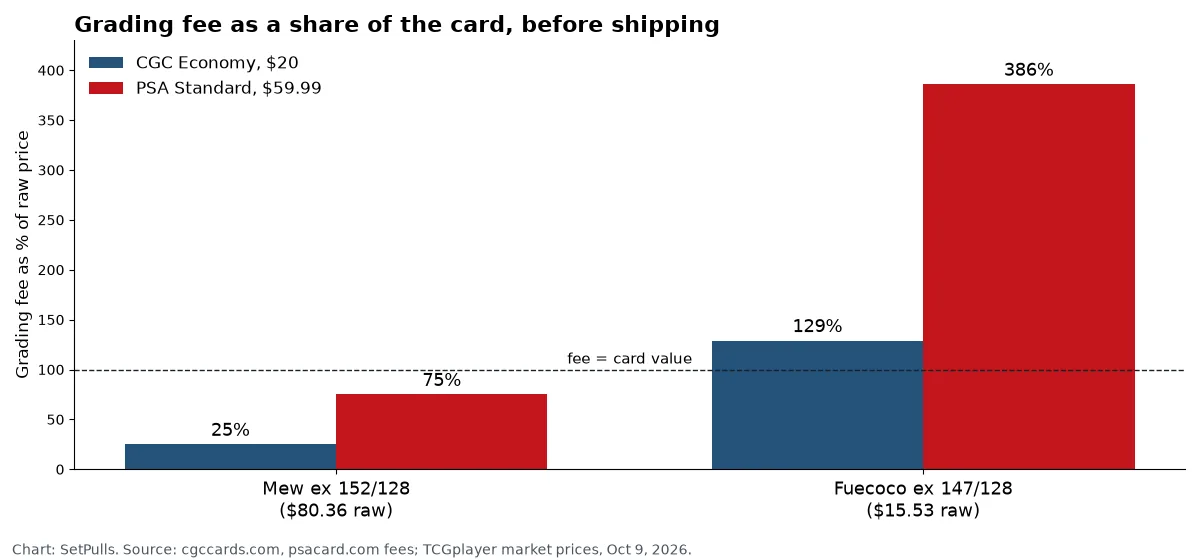 Chart: SetPulls. Source: CGC and PSA fee pages; TCGplayer market prices, October 9, 2026
The math decides most grading questions. On October 9, 2026, Mew ex 152/128 traded at $80.36 raw on TCGplayer. A $20 CGC Economy fee is about 25% of that, and PSA's $59.99 Standard about 75%. Fuecoco ex 147/128, one of the cheapest Special Illustration Rares in the set, was $15.53. Grading it costs more than the card: about 129% at CGC Economy and about 386% at PSA Standard, before shipping.
The top grades differ, too. PSA's Gem Mint 10 allows front centering of about 55/45, while CGC's Pristine 10 says "the centering is 50/50." A card that is perfectly fine as a raw Near Mint card may have no chance at either.
- PSA vs CGC vs BGS Grading Fees 2026: Prices and Wait Times: every open tier, wait times, value caps and the paused services.
Storage
Storage is about keeping the condition you paid for. The TCGplayer condition standard reads like a list of storage mistakes: it defines sun damage as "fading or yellowing caused by extreme or prolonged exposure to the sun," treats curl as damage past "more than 5mm of lift from flat surface at center," and counts "binder/sleeve gloss" as a kind of scuffing. Liquid is the worst: "any liquid exposure that results in the structural integrity of the card being compromised" makes a card Damaged.
In practice:
- Sleeve cards you care about as soon as they come out of the pack.
- Keep them flat and dry, away from liquids, and stored so they don't curl.
- Keep them out of direct sun, which fades and yellows cards over time.
- Watch binder wear. Cards sliding in and out of pages can pick up gloss scuffs.
 Product image: pokemon.com 30th Celebration product showcase
You may already own sleeves. Pokémon's product showcase lists "65 card sleeves" in the standard 30th Celebration Elite Trainer Box, enough for your best pulls from the box. Our 30th Celebration ETB breakdown lists the rest of its contents.
Binders are how most collectors enjoy a set. One reply in an r/PokemonTCG thread described a common setup: "I have binders for my commons, organized by Pokemon and some by artist." Valuable cards usually get extra protection on top. Graded cards come in their own case; PSA describes its cases as "sonically sealed, tamper-evident" and says they "provide protection from pressure and most damage."
Check new product as soon as you open it. Pokémon's support site only helps with manufacturing damage on products "released within the last year," and you must get in touch "within 10 business days of the original purchase date."
Card Values
Card values move every day, and nobody official tracks them. Pokémon's support site says: "The Pokémon Company International does not maintain or track any information on the secondary market value of our products." A price is only meaningful with a date and a source next to it.
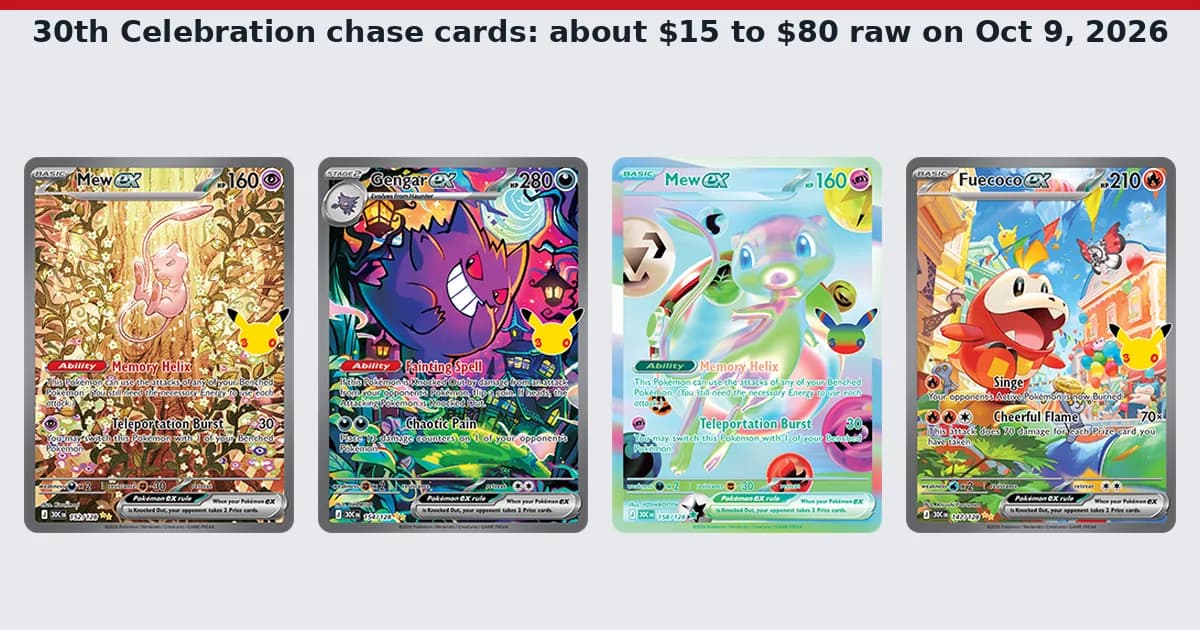
Here is what the 30th Celebration chase cards looked like on TCGplayer on October 9, 2026:
| Card (English, 30th Celebration) | TCGplayer market price, Oct 9, 2026 |
|---|---|
| Mew ex 152/128 (Special Illustration Rare) | $80.36 |
| Gengar ex 154/128 (Special Illustration Rare) | $74.81 |
| Mew ex 158/128 (Futuristic Rare) | $63.09 |
| Fuecoco ex 147/128 (Special Illustration Rare) | $15.53 |
Cards of the same rarity in the same set ran from about $15 to about $80, so the rarity on a card says little about its value. Condition shifts the price again, which is why TCGplayer sells raw cards by condition.
For the full list of chase cards and their rarities, see the 30th Celebration card list. For sealed products and what each costs per pack, see the Pokemon TCG products guide.
Analysis: what this Pokemon card collecting guide adds up to
Putting the four sections together, most avoidable losses come from four places.
Buying a fake. It is the only mistake that takes a card's value to zero. A minute with the back of the card and the official scan prevents most of it, and for sealed product, a price far below suggested retail is the warning Pokémon itself gives.
Overpaying for condition. A listing that says Near Mint is a claim, not a measurement. With the points system, you can check a card yourself: one patch of whitening or one crease changes the condition, and the price with it.
Grading the wrong cards. At $17 to $79.95 a card before shipping, grading eats most or all of the value of a card worth $15. It makes sense for cards where the fee is a small share of the value and the card has a real shot at a high grade, including centering.
Letting cards degrade. Sun, liquid, curl and binder scuffs all appear in the condition standard. Good storage is cheap compared with the drop from Near Mint to Lightly Played.
None of this needs expensive tools. A ruler, a bright light, sleeves and the official card database cover almost everything.
Our take
This take is based only on the official pages and sources cited above. The most useful habit a collector can build is checking things instead of trusting labels: the card is real because the back matches, it is Near Mint because the points add up, and grading is worth it because the fee is small next to a dated price. In October 2026, CGC's low fees make grading possible for more cards than PSA or Beckett, but for most modern cards under about $20, keeping them raw and well stored is the better choice.
Frequently Asked Questions
How do I start collecting Pokémon cards in 2026? Pick a goal first, such as one set, one Pokémon or a few chase cards, because it decides whether you open packs or buy singles. Then learn four skills in order: spotting fakes, judging condition, deciding when grading is worth the fee, and storing cards so they keep their condition.
What condition should I buy Pokémon cards in? For cards you plan to keep or resell, buy Near Mint, which allows up to 3 points of small flaws under TCGplayer's standard. Lightly Played, up to 6 points, is fine for binder cards and usually costs less. Any crease means the card is Moderately Played at best.
Is it worth grading Pokémon cards? Only when the fee is small next to the card's value. On October 9, 2026, CGC Economy cost $20 and PSA's cheapest open tier cost $59.99. That is about 25% and 75% of an $80 card, but more than the whole value of a $15 card.
How do I store Pokémon cards safely? Keep them sleeved, flat, dry and out of direct sun. TCGplayer's condition standard counts sun fading, liquid damage and curl over 5 mm against a card, and it lists binder and sleeve gloss as scuffing. Graded slabs add a sealed, tamper-evident case on top.
Does The Pokémon Company say what my cards are worth? No. Pokémon's support site says it does not maintain or track any information on the secondary market value of its products. Use dated market prices from a marketplace such as TCGplayer instead, and remember that condition changes what any card actually sells for.
References
- TCGplayer: Card Conditioning Overview
- TCGplayer: Understanding Card Condition Imperfections, A Comprehensive Guide
- TCGplayer: Card Conditioning Standards (PDF)
- PSA: trading card grading services and pricing
- PSA: grading standards
- CGC Cards: services and fees
- CGC Cards: grading scale
- Beckett: grading services status
- Beckett: temporary card grading submission form
- Pokémon Support: did I purchase fake or counterfeit cards?
- Pokémon Support: what are my cards worth?
- Pokémon Support: exchanging damaged cards and parts
- Pokemon.com: 30th Celebration product showcase
- Wargamer: how to identify fake Pokémon cards
- TCGplayer: 30th Celebration pull rates
- TCGplayer: Mew ex 152/128
- r/pokemoncardcollectors: what condition is this Gengar?
- r/PokemonTCG: Delta Reign card and artist thread
About the author

Editorial desk
The SetPulls desk. Every article is built from a source file: official Pokémon TCG announcements, published card lists, and dated market data, each linked in the article.
Keep reading
How to Spot Fake Pokemon Cards: 8 Checks That Still Work
Guides · 10 min
Pokemon Card Condition Guide: NM, LP, MP, HP and Damaged
Guides · 12 min
PSA vs CGC vs BGS Grading Fees 2026: Prices and Wait Times
Guides · 12 min
Pokemon TCG Release Dates 2026-2027: Every Official Date
Guides · 10 min
30th Celebration Pull Rates: Odds From 3,000+ Packs
Guides · 12 min

30th Celebration Elite Trainer Box: 9 Packs, MSRP, Promo
Guides · 10 min

30th Celebration Card List: All 158 Cards and Top Chases
Guides · 13 min

Pokemon TCG Products Guide 2026: ETBs, Bundles, Tins, UPCs
Guides · 14 min
Disclaimer
This article is published for informational and entertainment purposes. It does not constitute professional financial, legal, or technical advice. Game performance, online services, patch schedules, and store listings change. Verify critical details (pricing, system requirements, regional availability) with publishers and storefronts before you buy. Affiliate links, where present, help support our editorial work and are labelled in our affiliate disclosure.