Guides
How to Store Pokemon Cards: Sleeves, Toploaders, Binders
If you are working out how to store Pokemon cards, put each card in the cheapest layer that protects what it's worth to you. At list price a penny sleeve costs about four cents a card and a magnetic display holder close to four dollars, with binders, toploaders and semi-rigid holders in between. This guide walks through each layer with its specs and cost per card as of October 10, 2026.
TL;DR: Bulk upright in a card box; cards you want to look at in an acid-free, non-PVC binder; anything valuable in a penny sleeve plus a toploader (storage, trade) or a semi-rigid holder (grading). Magnetic one-touch holders are for display. Keep cards flat, dry and out of the sun. Pokémon does not replace cards damaged after purchase.
How to store Pokemon cards: the quick answer
Sleeve any card you care about, then choose the outer layer by what you plan to do with it: keep it in a binder, put it in a toploader, send it for grading in a semi-rigid holder, or display it in a magnetic holder. Every holder below is sized for standard cards, which Ultra PRO lists as 2-1/2 x 3-1/2 inches (63.5 x 88.9 mm), up to 35 points thick.
Key Takeaways
- Cost per card at Ultra PRO list prices (Oct 10, 2026): storage box $0.025, penny sleeve $0.04, binder pocket $0.16, semi-rigid $0.18, toploader $0.24, 4-card magnetic one-touch $3.75.
- Sleeve first. Penny sleeves are made to minimize surface scratches and go on before any rigid or semi-rigid holder.
- Toploader for storage and trade, semi-rigid for grading. CGC's packing instructions call for a semi-rigid sleeve.
- Storage damage is on you. Pokémon's support site says it cannot replace cards ruined by outside events.
Overview: why storage decides condition
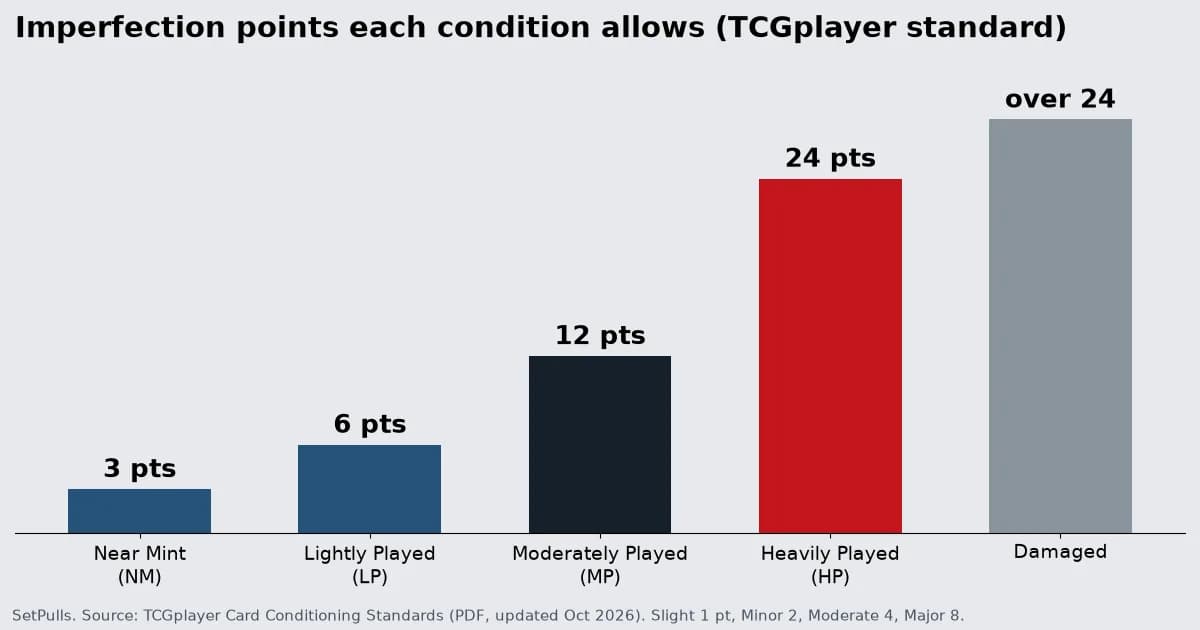
Several of the defects that lower a raw card's condition grade come from storage. The TCGplayer condition standard, which sellers use to grade raw cards as Near Mint to Damaged, lists several defects that come straight from storage: sun damage ("fading or yellowing caused by extreme or prolonged exposure to the sun"), curling past "more than 5mm of lift from flat surface at center", and "binder/sleeve gloss" as a type of scuffing. A crease, the classic result of a card loose in a box or pocket, "drops the condition to Moderately Played at best."
Pokémon won't cover storage damage. Its support site says: "We are unable to replace cards that have been ruined or damaged by outside events." Exchanges cover manufacturing damage only, on products "released within the last year", reported "within 10 business days of the original purchase date", and "cards with minor scratching or printing defects do not qualify for exchange."
For how each of those defects maps to NM, LP, MP and HP, see the Pokemon card condition guide.
What each storage layer costs per card
Knowing how to store Pokemon cards is partly a budget question. Here is each common layer, using one Ultra PRO product per type so the prices come from a single list. Prices are the list prices shown on ultrapro.com on October 10, 2026, divided by how many cards each product holds.
| Layer | Ultra PRO product (list price, Oct 10, 2026) | Holds | Cost per card |
|---|---|---|---|
| Storage box | 2-piece clear box ($4.99) | 200 cards | $0.025 |
| Penny sleeve | 100ct Penny Sleeves ($3.99) | 100 cards | $0.04 |
| Binder pocket | Zippered 9-pocket binder ($28.99) | 180 sleeved cards | $0.16 |
| Semi-rigid holder | 1/2" lip semi-rigid, 200ct ($35.99) | 200 cards | $0.18 |
| Toploader | 3" x 4" regular toploader, 25ct ($5.99) | 25 cards | $0.24 |
| Magnetic one-touch | 4-card UV magnetic holder ($14.99) | 4 cards | $3.75 |
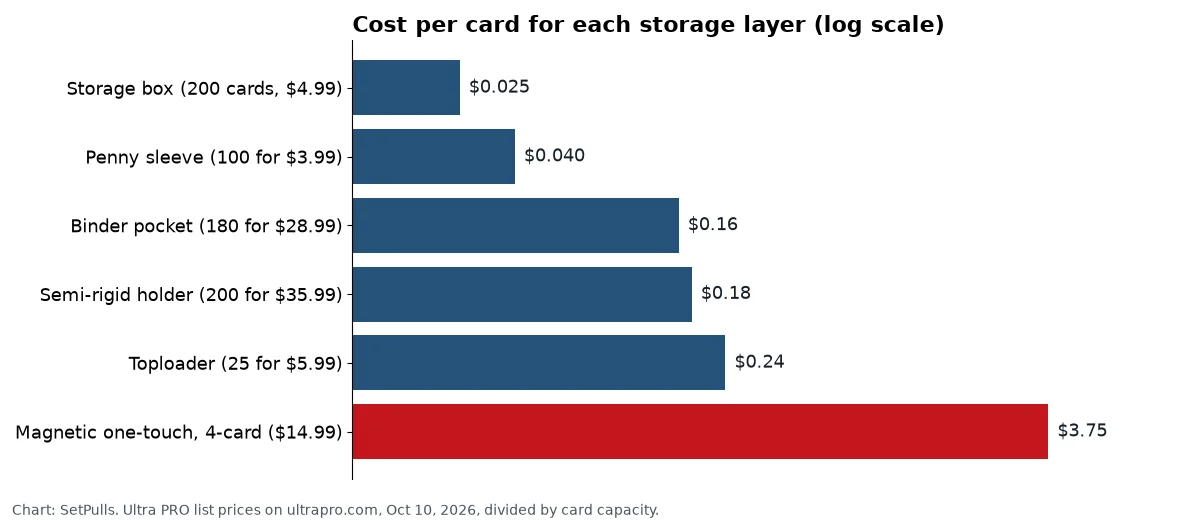 Source: ultrapro.com list prices, Oct 10, 2026. Chart: SetPulls.
A penny sleeve plus a toploader comes to about $0.28 a card, which is why that pair is the default for anything you would be upset to see scratched. Magnetic holders cost roughly fifteen times more per card than a toploader, so they make sense for the few cards you actually display. Other brands and multi-packs price differently, and these figures are one dated snapshot from one maker.
Step-by-Step: how to store Pokemon cards by layer
1. Sort bulk into a card box. Commons and duplicates don't need sleeves. A 2-piece clear box "holds up to 200 Standard Size cards," is stackable, and is listed as "No PVC / Acid-Free." Stand cards upright and fill the box enough that they cannot slide around, which is how corners get dinged.
2. Put any card you care about in a penny sleeve. Ultra PRO describes its penny sleeves as "made with non-PVC, archival safe, and acid-free polypropylene film," sized for standard cards "up to 35 points in thickness," and made to "minimize surface scratches." A grading glossary from Majesty defines the penny sleeve the same way collectors use it: "a thin plastic sleeve used to protect a raw card before it goes into a semi-rigid holder." If you just bought an Elite Trainer Box, you may already have sleeves: Pokémon lists "65 card sleeves" in the standard 30th Celebration ETB.
3. Use a binder for cards you want to see. For a binder, look for side-loading pockets and materials listed as acid-free and non-PVC. Ultra PRO's zippered binder has "twenty 9-pocket pages sized for standard trading cards in side-loading pockets," for up to 180 sleeved cards. Because the TCGplayer standard counts binder and sleeve gloss as scuffing, put cards in once and leave them, and don't pull them out every time you show the binder. Binder collectors also tolerate wear that matters elsewhere. One collector in a thread about raw card condition wrote: "I love buying cheap copies of expensive cards with the backsl beaten up to go in the binder, but a big crease right across the art is a turn off for me."
 Product image: pokemon.com
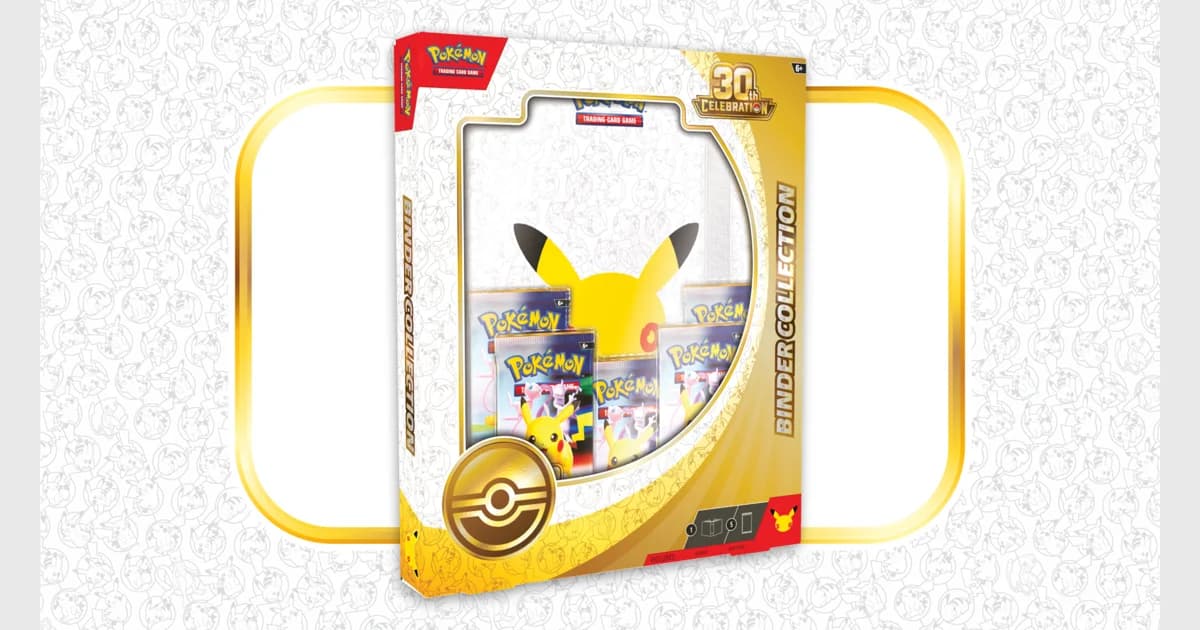
Pokémon sells binders too. Its October 2026 product list says you can "store up to 60 of your latest and greatest Pokémon cards in this mini portfolio," which comes with one booster pack. The 30th Celebration Binder Collection is a 9-pocket binder with five booster packs, due December 4, 2026; our Pokemon TCG products guide compares it with the other sealed products.
GODEEPER: Before a card goes into a sleeve and toploader, check that it is genuine. How to Spot Fake Pokemon Cards: 8 Checks That Still Work →
4. Move valuable cards into a toploader. For storage, trades and shipping, a sleeved card goes into a toploader. Ultra PRO's regular toploaders are "rigid plastic protectors" in "super clear PVC," meant to keep cards "safe for storage, display, during trade, and in shipments," with 3 x 4 inch outer dimensions for standard cards up to 35 points thick. Note the material: this toploader is PVC, while the sleeves, binder and box above are listed as non-PVC. Store toploaders upright in a box so they don't bow. A reply in an r/pokemoncardcollectors thread, about a Neo Genesis Lugia of uncertain condition, gave the same advice in one line: "Put it in a sleeve and toploader. If you have to touch it, grab it by the edges not sandwiched between your fingers."
5. Use a semi-rigid holder for grading. If a card is going to PSA, CGC or Beckett, use a semi-rigid holder instead. Ultra PRO's 1/2 inch lip holders are "made with clear PVC," fit cards up to 63.5 x 88.9 mm and 35 points, and come 200 to a box; the product page calls the tall version "the ideal protection choice for graded card submissions." The lip makes it easy for a grader to pull the card out.
6. Pack submissions the way the grader asks. CGC's official instructions read: "place each card into a protective sleeve. Then, place each card in a semi-rigid sleeve," which "must be sturdy enough to allow us to remove the card safely." Then stack them "in between two cardboard pieces that are larger than the cards," hold them with rubber bands, pad the bundle and ship it in a sturdy box.
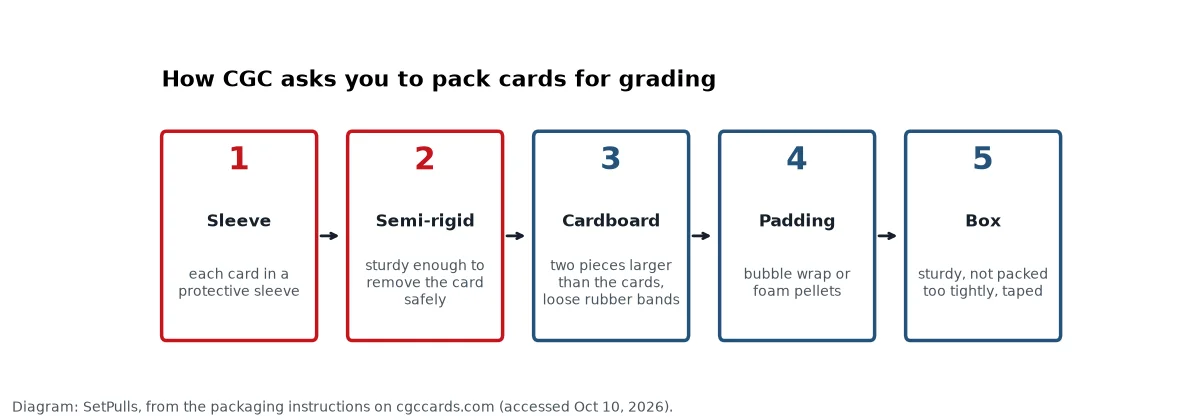 Source: cgccards.com packaging instructions. Diagram: SetPulls.
CGC adds two warnings. "Ensure that the rubber bands are not too tight," because "if packed too tightly, the cards inside may get damaged." And CGC says its instructions "are only suggestions": "You are responsible for safely shipping your cards to CGC."
7. Display the few cards that earn it. Magnetic one-touch holders are display cases. Ultra PRO describes a "two-piece ONE-TOUCH" holder with a "slide-in hinge and magnetic closure" and "UV-resistant, no-PVC and acid free protection"; the 4-card model "can hold four standard cards" up to 35pt. At $14.99 for four cards on October 10, 2026, it is the most expensive layer per card in this guide, so it is worth it only for cards you want on a shelf.
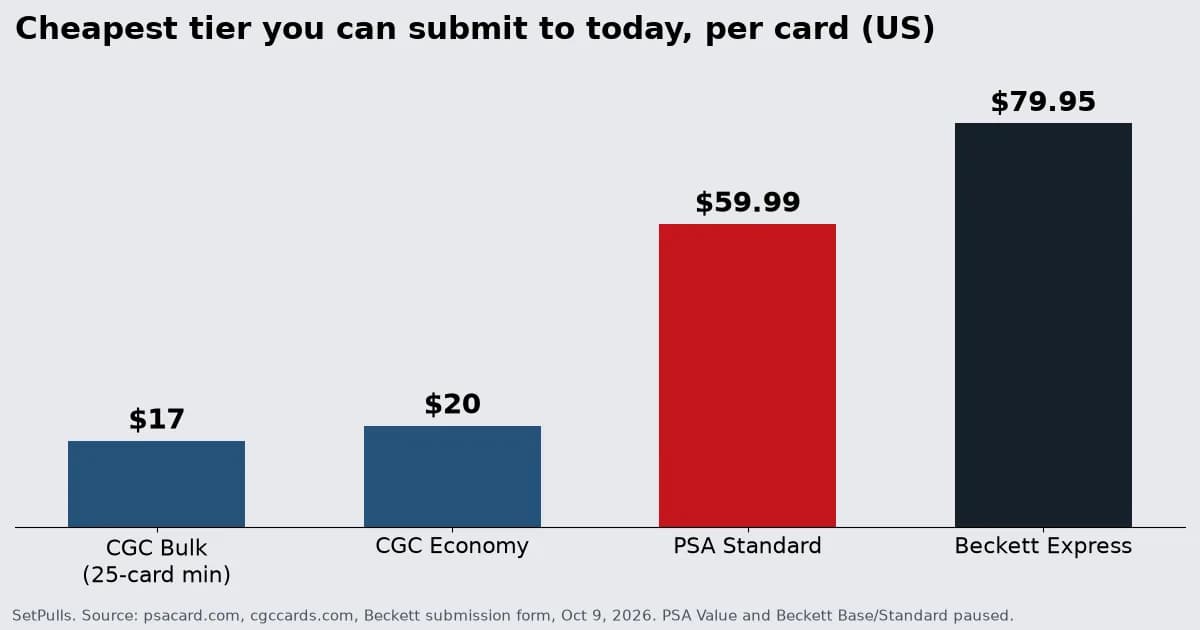
GODEEPER: What it costs to send a card to PSA, CGC or Beckett in 2026, tier by tier. PSA vs CGC vs BGS Grading Fees 2026 →
Tips: storage mistakes to avoid
- Rubber bands on raw cards. CGC warns that even in a packed submission, bands that are too tight can damage cards. Around a loose stack they dent edges.
- Cards in the sun. Sun fading and yellowing is a listed defect in the TCGplayer standard. Keep binders and displays away from windows.
- Damp or warm places. Curl past 5 mm counts as damage under the same standard; keep boxes off floors and out of attics.
- Sliding cards in and out of binder pockets. Gloss scuffing from binders and sleeves is a listed defect.
- A valuable card in a penny sleeve alone. A sleeve stops scratches but does nothing against bends. A crease limits a card to Moderately Played at best.
- Waiting to check new product. Pokémon's exchange window for manufacturing damage is 10 business days from purchase.
Our take
Based on the specs and prices cited above, the layered answer to how to store Pokemon cards is cheap where it matters: sleeving and toploading a card costs well under thirty cents at list price, while the condition it protects is what sets the card's price. Spend on binders for the cards you enjoy and on semi-rigid holders only when you are ready to grade. Magnetic holders are optional, for display. Whatever you buy, check that the product lists its material, since not every holder in this guide is non-PVC. For the wider picture of condition, grading and fakes, start with the Pokemon card collecting guide.
Frequently Asked Questions
What is the best way to store Pokemon cards? Store them in layers matched to what each card is worth to you. Bulk goes upright in a card box, cards you like go in a binder, and valuable cards go in a penny sleeve plus a toploader or semi-rigid holder. Keep everything flat, dry and out of direct sun.
Should Pokemon cards go in a penny sleeve before a toploader? Yes. Ultra PRO describes its penny sleeves as soft protectors that minimize surface scratches, and a grading glossary from Majesty defines the penny sleeve as the thin sleeve that protects a raw card before it goes into a semi-rigid holder. The same order works for a toploader: sleeve first, then the rigid holder.
Toploader or semi-rigid holder: which should I use? A toploader is a rigid PVC holder for storage, display, trade and shipping. A semi-rigid holder is flexible, has a lip for easy handling, and is the format CGC asks for with grading submissions. At Ultra PRO list prices on Oct 10, 2026, a toploader cost about $0.24 per card and a semi-rigid $0.18.
Are binders safe for Pokemon cards? Binders made with acid-free, non-PVC materials and side-loading pockets are built for card storage. The TCGplayer condition standard lists binder or sleeve gloss as a kind of scuffing, so avoid sliding valuable cards in and out often. A zippered 9-pocket binder holds up to 180 sleeved cards.
Will Pokemon replace cards that get damaged in storage? No. Pokémon's support site says it is unable to replace cards that have been ruined or damaged by outside events. Exchanges cover manufacturing damage only, on products released within the last year, reported within 10 business days of purchase, and minor scratching does not qualify.
How should I pack Pokemon cards to send for grading? CGC asks for each card in a protective sleeve and then a semi-rigid sleeve, stacked between two pieces of cardboard larger than the cards, held with rubber bands that are not too tight, padded with packing material and shipped in a sturdy box. CGC calls these suggestions; you are responsible for safe packing.
Related Reading
- 30th Celebration Elite Trainer Box: Contents and MSRP: the ETB that ships with 65 sleeves.
- 30th Celebration Card List: All 158 Cards and Top Chases: the current set's chase cards, the ones most worth a toploader.
- 30th Celebration Pull Rates: Odds From 3,000+ Packs: how often those chase cards turn up in a pack.
References
- Exchanging Damaged Cards and Parts, Pokémon Support
- My cards were ruined, can you replace them?, Pokémon Support
- Pokémon TCG: 30th Celebration Product Showcase, pokemon.com
- Every Pokémon TCG product release in October 2026, pokemon.com
- Shipping your cards to CGC: packaging instructions, CGC Cards
- Understanding Card Condition Imperfections, TCGplayer Help Center
- Glossary of grading terms, Majesty Grading
- Ultra PRO product pages (list prices Oct 10, 2026): penny sleeves, toploaders, semi-rigid holders, magnetic one-touch, zippered binder, storage box
- Reddit threads quoted: Neo Genesis Lugia condition and raw card condition, r/pokemoncardcollectors
Was this guide helpful?
About the author

Editorial desk
The SetPulls desk. Every article is built from a source file: official Pokémon TCG announcements, published card lists, and dated market data, each linked in the article.
Keep reading

Pokemon Card Collecting Guide 2026: Condition to Grading
Guides · 14 min
How to Spot Fake Pokemon Cards: 8 Checks That Still Work
Guides · 10 min
Pokemon Card Condition Guide: NM, LP, MP, HP and Damaged
Guides · 12 min
PSA vs CGC vs BGS Grading Fees 2026: Prices and Wait Times
Guides · 12 min
Pokemon TCG Release Dates 2026-2027: Every Official Date
Guides · 10 min
30th Celebration Pull Rates: Odds From 3,000+ Packs
Guides · 12 min

30th Celebration Elite Trainer Box: 9 Packs, MSRP, Promo
Guides · 10 min

30th Celebration Card List: All 158 Cards and Top Chases
Guides · 13 min
Disclaimer
This article is published for informational and entertainment purposes. It does not constitute professional financial, legal, or technical advice. Game performance, online services, patch schedules, and store listings change. Verify critical details (pricing, system requirements, regional availability) with publishers and storefronts before you buy. Affiliate links, where present, help support our editorial work and are labelled in our affiliate disclosure.