Guides
How to Check Pokemon Card Value: Sold Prices vs Asking
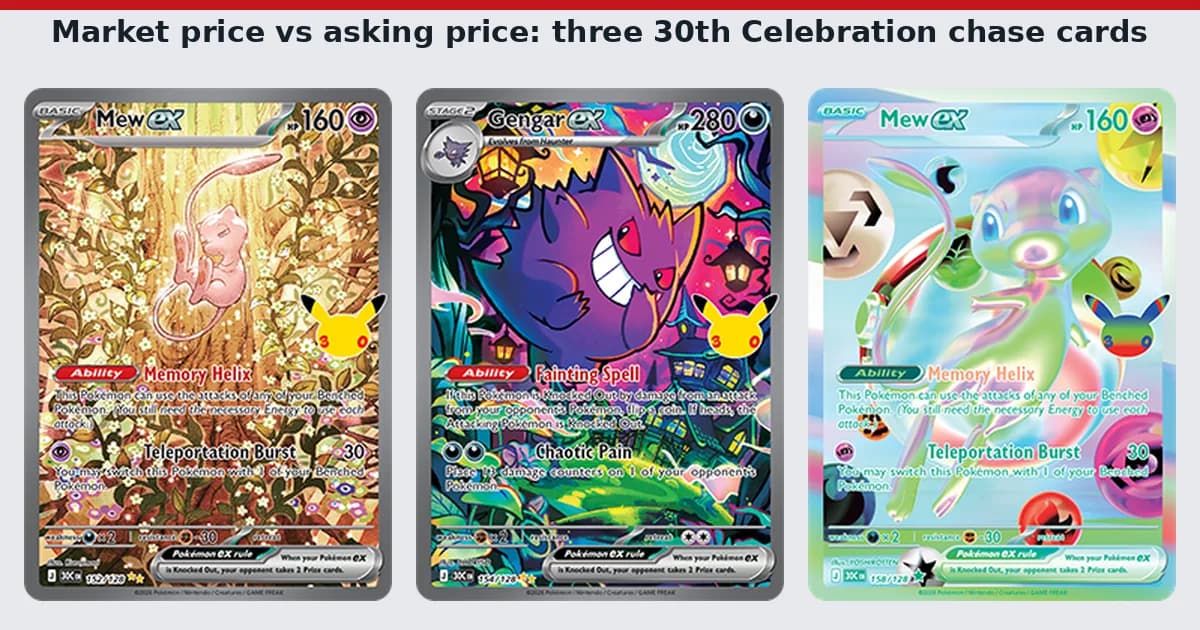
How to check Pokemon card value comes down to one rule: use what cards sold for, not what sellers are asking. On October 12, 2026, TCGplayer's listed median sat above the market price for every 30th Celebration card we checked: 15% above for Mew ex 152/128, about 25% on average for the six chase cards over $50, and up to 82% for a cheap Pikachu rare. This guide shows where each number comes from and gives five steps to price a card yourself.
TL;DR: Identify the exact card (set, collector number, printing), grade its condition honestly, then read TCGplayer's market price with the printing and condition filters set. Confirm it against eBay sold listings from the last 90 days. Ignore asking prices: on October 12, 2026, Mew ex 152/128 had a market price of $86.74 against a listed median of $100.00. Write the date next to any price you record.
How to check Pokemon card value: the quick answer
Find the card's TCGplayer market price, which TCGplayer builds from recent completed sales, with the filters set to your card's printing and condition. Check the same card in eBay's sold listings. If the two agree, that is your value for today. Don't use the lowest or the median asking price: on October 12, 2026, asking prices for 30th Celebration cards ran 15% to 82% above what the same cards actually sold for.
Key Takeaways
- Pokémon doesn't price cards. The Pokémon Company International says it does not track secondary market values and cannot advise on resale prices.
- Market price is sales; listed median is asking. TCGplayer builds market price from recent completed sales. Its listed median is only the median of current listings.
- Asking prices run high. On October 12, 2026 the listed median beat market price on all 11 cards we checked, by 15% to 82%.
- eBay sold listings cover 90 days. eBay's Product research goes back 3 years and shows the real price when a Best Offer was accepted.
- Every value needs a date. Mew ex 152/128 moved from $80.76 to $88.36 to $86.74 between October 9 and October 12, 2026.
Overview: where a Pokemon card's value comes from
There is no official price list. Pokémon's support site says the company "does not maintain or track any information on the secondary market value of our products" and is "unable to provide any guidance on the resale value." A card is worth what buyers are paying for it right now, so learning how to check Pokemon card value really means learning to find recent sales of the exact same card in the same condition.
Two tools carry most of the weight for English cards: TCGplayer's price points and eBay's sold listings. Both are built from completed sales, and both let you narrow results to a condition.
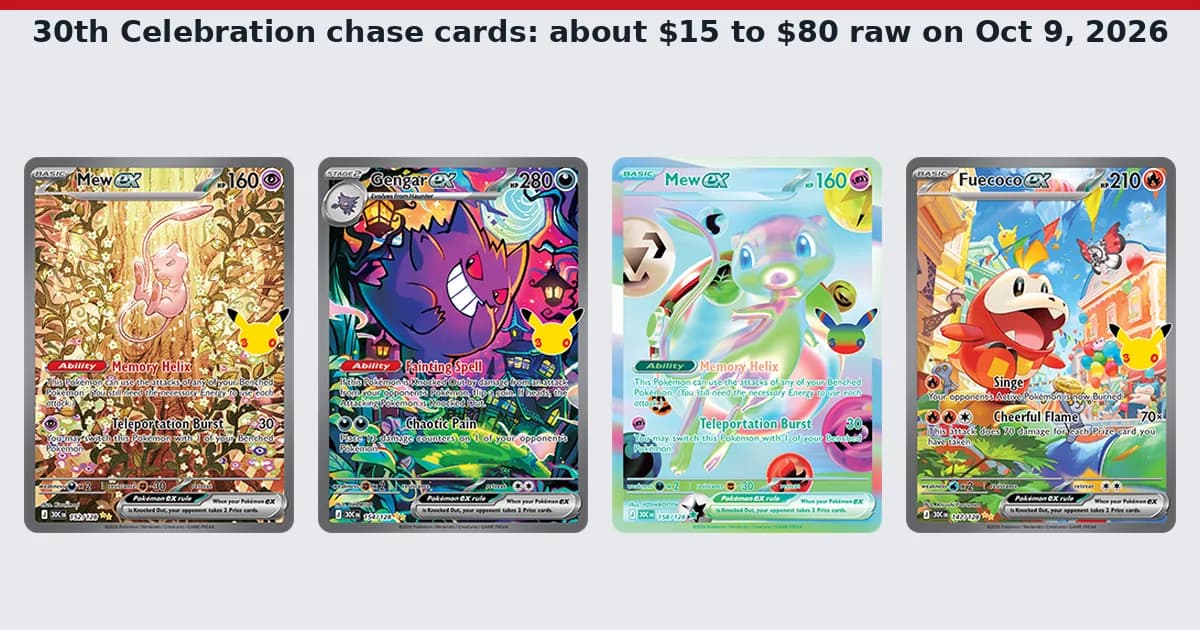
Rarity won't give you a price either. CGC, which grades cards, writes that "It is impossible to determine a rare card's value just by checking the rarity symbol." On October 12, 2026, six 30th Celebration special illustration rares and the Futuristic Mew ex, all high-rarity cards, ranged from $52.59 to $86.74 on TCGplayer.
The two TCGplayer numbers that matter
Every TCGplayer product page shows several price points. For checking value, two of them matter most, and they measure different things.
Market price is built from sales. TCGplayer's help page says it is "compiled from recent sales completed on TCGplayer.com" and "updated as transactions complete." Its separate explainer adds that market price averages "across multiple recent transactions" while ignoring outliers, and that it works "Instead of relying on currently listed prices".
Listed median is built from listings. In TCGplayer's words, "This is the median from all listed prices for a product based on listed prices only." It "can vary significantly from the actual price that people are paying."
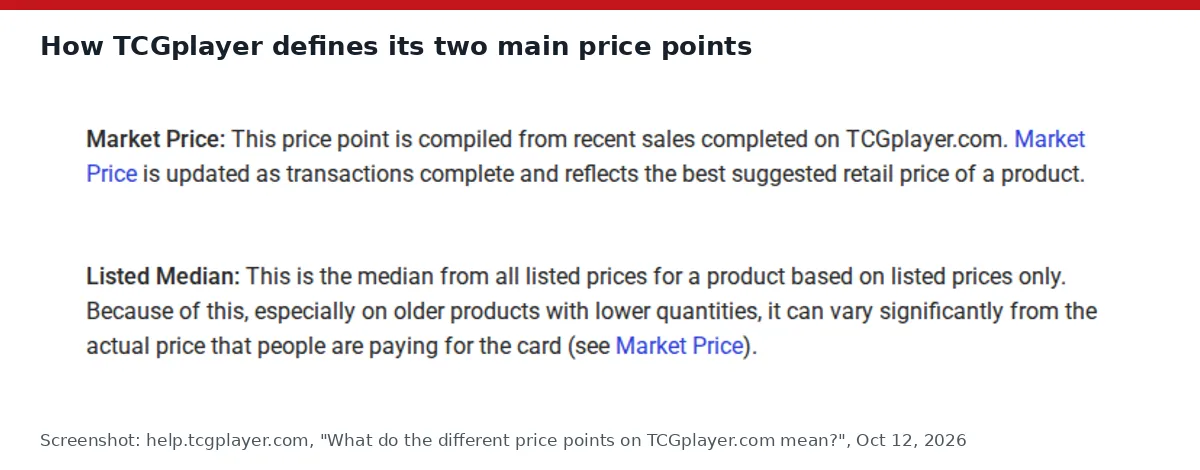 Source: help.tcgplayer.com, screenshot Oct 12, 2026
TCGplayer also explains why listings drift upward. Copies listed near the market price sell, which leaves behind cards "with listed prices far above what the card will sell for."
Two more price points help. Most Recent Sale shows the last sold price for the condition and version you selected. Market Price Volatility is calculated over 30 days; when a card has too few sales in that window, TCGplayer marks it indeterminate, which is a sign to lean on eBay sales as well. All of these numbers "reflect any selected printings and conditions filters," so set the filters before you read them.
What sold vs asking looks like on real cards
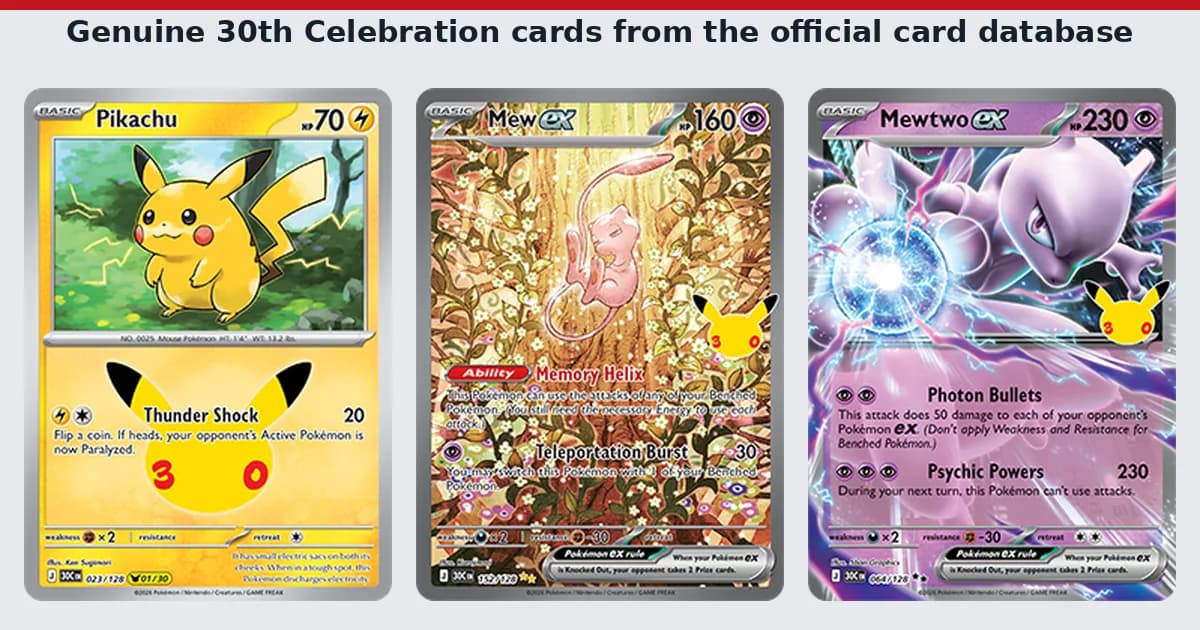
We pulled TCGplayer's market price and listed median for 11 English 30th Celebration cards on October 12, 2026, all foil printings.
| Card (English, 30th Celebration) | Market price | Listed median | Asking above sold |
|---|---|---|---|
| Mew ex 152/128 (SIR) | $86.74 | $100.00 | +15% |
| Gengar ex 154/128 (SIR) | $74.67 | $94.00 | +26% |
| Mew ex 158/128 (Futuristic) | $62.93 | $78.25 | +24% |
| Pikachu ex 150/128 (SIR) | $59.01 | $74.99 | +27% |
| Mewtwo ex 151/128 (SIR) | $58.11 | $73.80 | +27% |
| Pikachu ex 149/128 (SIR) | $52.59 | $69.49 | +32% |
| Maushold 146/128 (IR) | $12.23 | $14.86 | +22% |
| Moltres 130/128 (IR) | $5.96 | $8.25 | +38% |
| Pikachu 040/128 (Pikachu rare) | $2.13 | $2.90 | +36% |
| Pikachu 036/128 (Pikachu rare) | $0.96 | $1.50 | +56% |
| Pikachu 051/128 (Pikachu rare) | $0.55 | $1.00 | +82% |
TCGplayer market price and listed median, Oct 12, 2026.
Asking prices sat above sales on every card. For the six cards over $50 the gap averaged about 25%, so pricing a Gengar ex from its listings would have overstated it by about $19. And the cheapest cards drifted furthest: a Pikachu rare that sells for $0.55 had a median asking price of $1.00, nearly double.
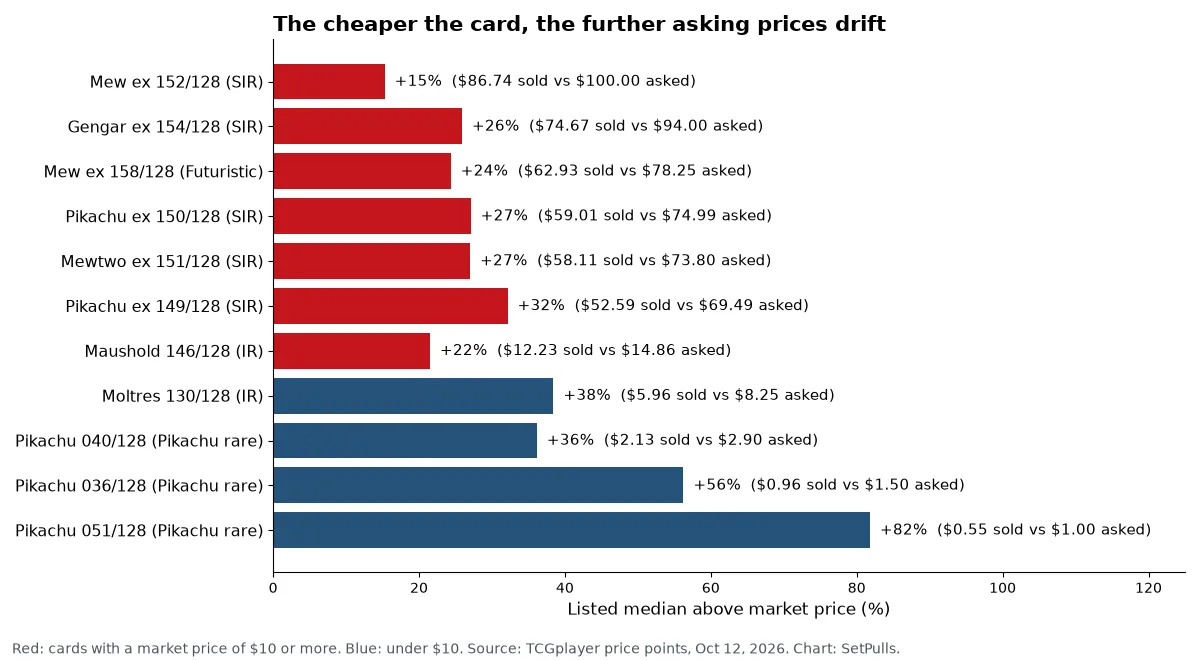 Source: TCGplayer price points, Oct 12, 2026. Chart: SetPulls
GODEEPER: Rarity decides how often a card turns up, not what it sells for. See what each star and shape means. Pokemon Card Rarity Symbols Explained →
Checking eBay sold listings
eBay is the second check, and the main one for graded cards. TCGplayer sells raw cards in Near Mint, Lightly Played, Moderately Played, Heavily Played and Damaged condition, and states that "Mint or Gem Mint cards are not sold on TCGplayer". Prices for PSA, CGC or BGS slabs therefore have to come from elsewhere, such as eBay sales.
The public sold filter has a limit. eBay's help page says "eBay completed listings results include only listings that have recently ended sold in the previous 90 days." For a longer view, eBay's Product research tool "gives you access to the last 3 years of eBay sales data" and shows "the actual price that the item sold for, even if a Best Offer was accepted." eBay lists that as one of the ways Product research differs from a completed listings search. "Sellers with access to Seller Hub can use Product research," and it can filter by item condition.
Match condition carefully on eBay. One collector on r/PokeInvesting summed up the difference between the two sites:
"Tcgplayer is best for low value raw cards based on loose grading like NM/LP/MP etc", while "eBay ungraded sales includes all raw," so a sold price there can mix conditions.
Step-by-Step: how to check Pokemon card value
Five steps take you from a card in your hand to a dated value.
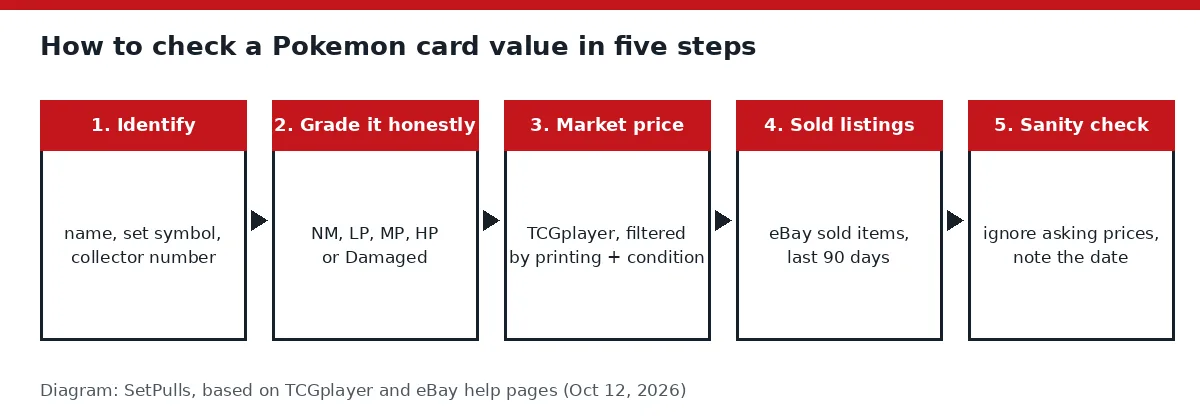 Source: diagram by SetPulls, based on TCGplayer and eBay help pages
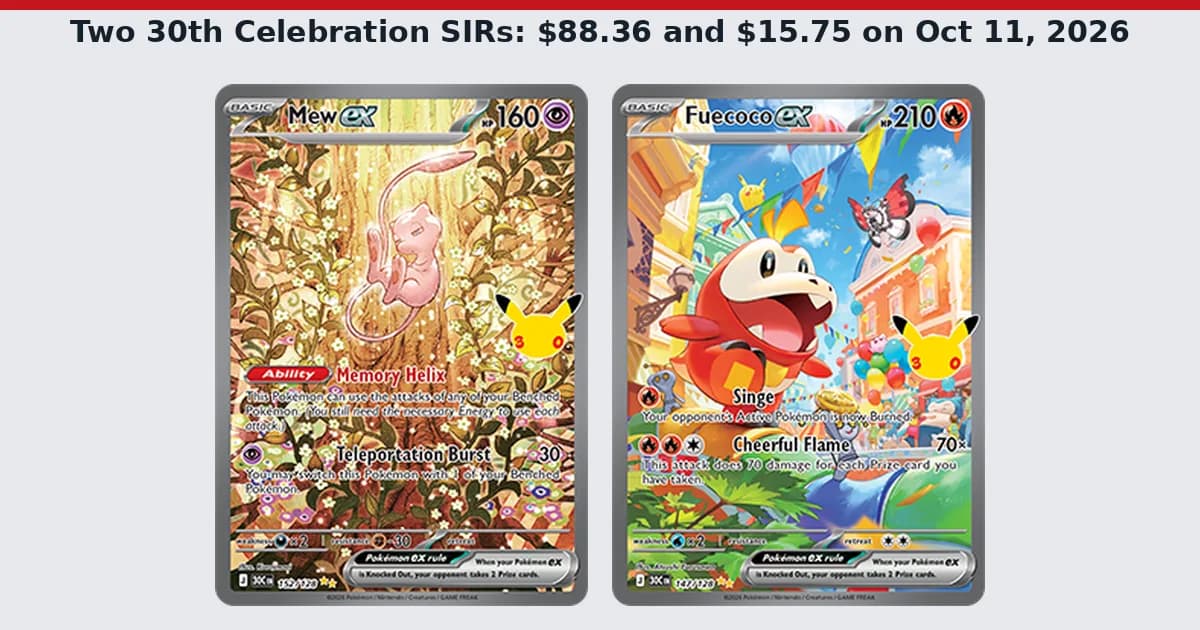
1. Identify the exact card. Look up the name in Pokémon's official card database, which can "Search for a card by what set it appears in." Note the set symbol, the collector number and the rarity symbol, which CGC says sits in the bottom right or bottom left "adjacent to the set number." The same Pokémon often has several cards in one set at very different prices: Mew ex 152/128 and Mew ex 158/128 were $86.74 and $62.93 on October 12, 2026.
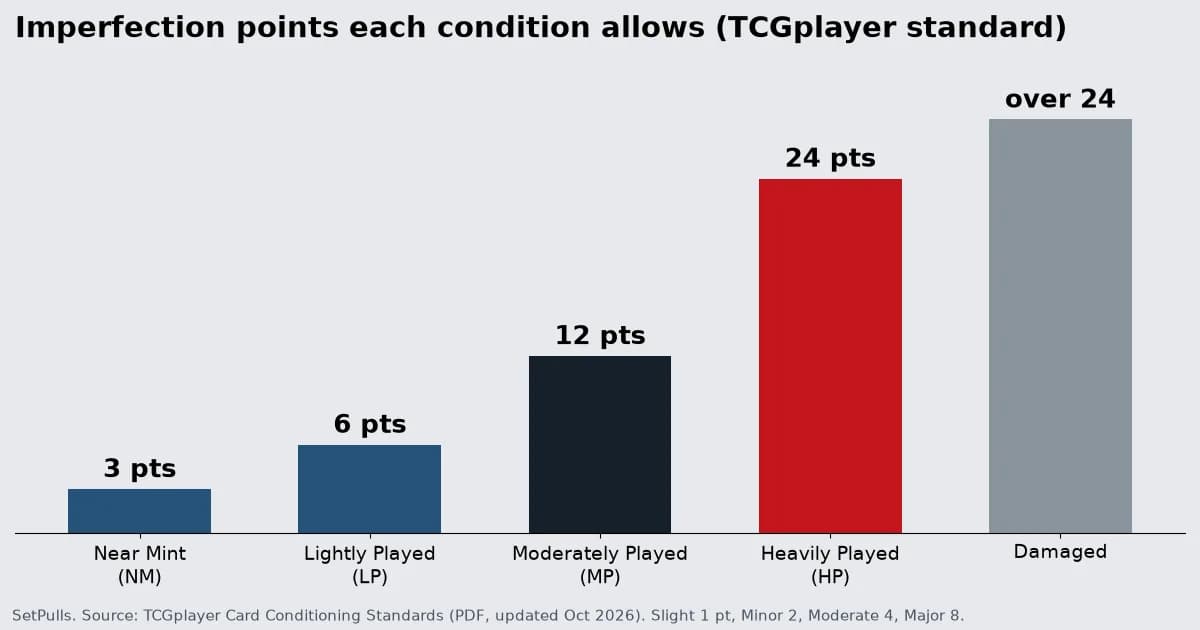
2. Grade the condition honestly. Compare the card with TCGplayer's five conditions. A single grade lower changes which sales you should compare against. Our Pokemon card condition guide shows what each grade allows.
3. Read the TCGplayer market price with filters set. Choose the right printing (normal, reverse holo or foil) and your condition, then read market price and most recent sale. If volatility says indeterminate, there aren't enough recent sales to trust the number on its own.
4. Check eBay sold listings. Turn on the sold filter and compare sales of the same card in the same condition from the last 90 days. For a graded card, match the grading company and the grade exactly. Another collector in the same thread prices by averaging recent sales: "I do last 5 sales on TCG player and divide by 5 for average price. And eBay."
5. Ignore asking prices and write down the date. Treat listings as an upper bound. Record the price with the date you checked, because prices for new sets move daily: Mew ex 152/128 had a market price of $80.76 on October 9, $88.36 on October 11 and $86.74 on October 12, 2026.
GODEEPER: Once you know the value, fees decide what you actually keep. How to Sell Pokemon Cards: TCGplayer vs eBay Fees →
Tips: how to check Pokemon card value without the common mistakes
- Don't price from the cheapest or the median listing. On October 12, 2026 the listed median was above market price on all 11 cards we checked.
- Don't trust a value without a date. A price from last week can be several dollars off for a set that released in September 2026.
- Match the printing. TCGplayer's numbers follow the printing filter, so a reverse holo and a regular copy of the same card have separate prices.
- Keep raw and graded apart. TCGplayer doesn't sell Mint or Gem Mint cards, so graded slabs need eBay sales. Our PSA vs CGC vs BGS comparison covers what grading costs.
- Expect cheap cards to look more valuable than they are. Under a few dollars, asking prices ran 36% to 82% above sales in our sample.
Our take
Based on the cited TCGplayer and eBay data, the most common mistake in checking a card's value is reading the wrong number. Listings are the most visible price on any marketplace, and on October 12, 2026 they were above real sales on every card we checked, by about a quarter for the expensive 30th Celebration cards and by much more for the cheap ones. If you want one habit for how to check Pokemon card value, use TCGplayer's market price with the right filters, confirm it with eBay sold listings, and keep the date next to the number.
Frequently Asked Questions
What is the most accurate way to check a Pokemon card's value? Use prices from completed sales, not asking prices. TCGplayer's market price is compiled from recent sales on its site and can be filtered by printing and condition. Check it against eBay sold listings from the last 90 days, match the condition, and write down the date you checked.
What is the difference between market price and listed median on TCGplayer? Market price comes from recent completed sales. Listed median is the median of prices sellers are asking right now. On October 12, 2026, the listed median sat above market price for every 30th Celebration card we checked, from 15% for Mew ex 152/128 to 82% for a cheap Pikachu.
Can Pokemon tell me what my cards are worth? No. The Pokémon Company International says it does not track the secondary market value of its products and cannot give guidance on resale value. Its card database helps you identify the exact card, set and rarity, but the price has to come from marketplace sales data.
Does the rarity symbol tell you what a card is worth? No. CGC puts it plainly: you cannot determine a rare card's value from the rarity symbol alone. On October 12, 2026, six 30th Celebration special illustration rares and the Futuristic Mew ex ranged from $52.59 to $86.74 on TCGplayer, all carrying high-rarity symbols.
How far back do eBay sold listings go? eBay's completed listings search shows listings that ended sold in the previous 90 days. Sellers with Seller Hub access can use eBay's Product research tool, which covers the last 3 years and shows the actual price paid when a Best Offer was accepted.
Why does the same card show different prices on different days? Market prices update as sales complete. Mew ex 152/128 from 30th Celebration had a TCGplayer market price of $80.76 on October 9, $88.36 on October 11 and $86.74 on October 12, 2026. A value is only useful with the date you checked it.
Related Reading
- Pokemon Card Collecting Guide 2026: condition, grading, storage, fakes and card values in one place.
- 30th Celebration Card List and Chase Cards: every card in the newest English set and which ones collectors chase.
- How to Spot Fake Pokemon Cards: check a valuable card is real before you price it.
References
- Pokémon Support: What are my cards worth?
- Pokémon Support: How do I use the Trading Card Game database?
- TCGplayer: TCGplayer Market Price
- TCGplayer: What do the different price points on TCGplayer.com mean?
- TCGplayer: Card Conditioning Overview
- TCGplayer: Mew ex 152/128 (30th Celebration)
- eBay: Product research
- CGC Cards: Pokémon rarity symbols
- r/PokeInvesting: How to determine the "market price" of a card?
Was this guide helpful?
About the author

Editorial desk
The SetPulls desk. Every article is built from a source file: official Pokémon TCG announcements, published card lists, and dated market data, each linked in the article.
Keep reading
Japanese vs English Pokemon Cards: Packs, Prices, Timing
Guides · 11 min
How to Sell Pokemon Cards: TCGplayer vs eBay Fees (2026)
Guides · 12 min
Pokemon Card Rarity Symbols Explained: Every Star and Shape
Guides · 14 min

How to Store Pokemon Cards: Sleeves, Toploaders, Binders
Guides · 12 min
Pokemon Card Collecting Guide 2026: Condition to Grading
Guides · 15 min
How to Spot Fake Pokemon Cards: 8 Checks That Still Work
Guides · 10 min
Pokemon Card Condition Guide: NM, LP, MP, HP and Damaged
Guides · 12 min
PSA vs CGC vs BGS Grading Fees 2026: Prices and Wait Times
Guides · 12 min
Disclaimer
This article is published for informational and entertainment purposes. It does not constitute professional financial, legal, or technical advice. Prices, release dates and store listings change. Verify critical details (pricing, product contents, regional availability) with the retailer before you buy. Affiliate links, where present, help support our editorial work and are labelled in our affiliate disclosure.