Guides
How to Spot Fake Pokemon Cards: 8 Checks That Still Work
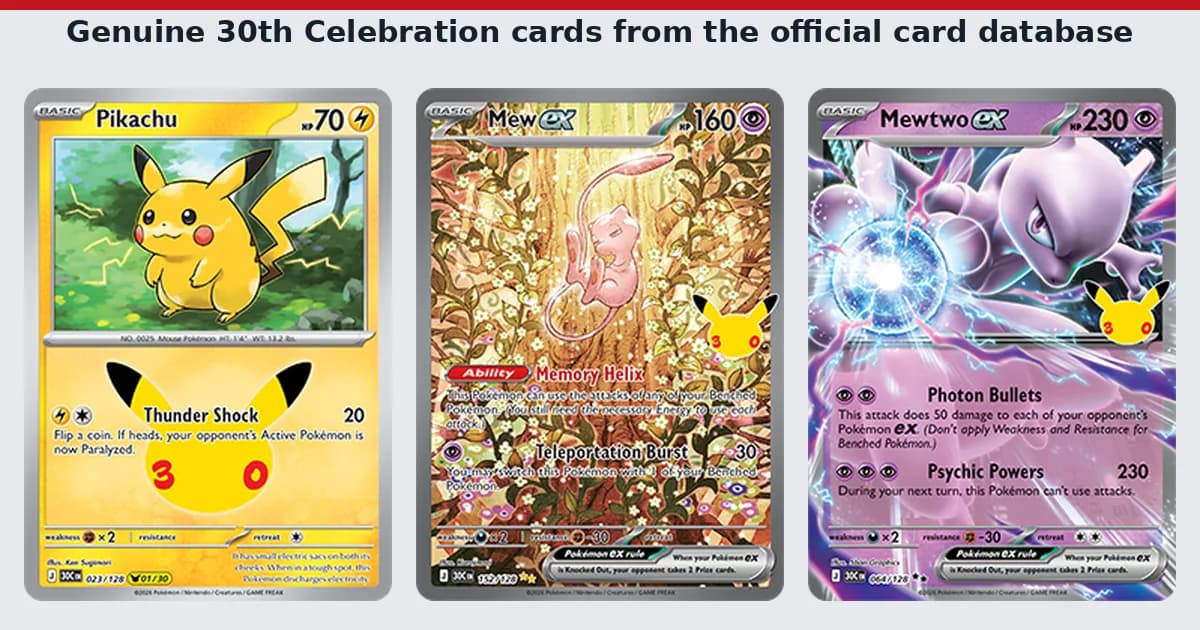
How to spot fake Pokemon cards comes down to one habit: compare the card in your hand with a card you know is real. The Pokémon Company's own support site and the collector guides agree on the same short list of tells, and most fakes fail at least one of them in under a minute. Here are eight checks, from the quickest to the ones that need a genuine card next to yours.
TL;DR: Pull up the official scan of the same card, then check: the back (washed-out or lighter blue is the classic tell), fonts and the é in Pokémon, energy symbols, the copyright line, size (63 x 88 mm), the light test and the finish. Skip the rip test unless you don't mind destroying the card. For sealed packs, price and seller matter most.
How to spot fake Pokemon cards: the quick answer
Put the card next to a genuine one, or next to the scan on Pokémon's official card database, and look for differences. Check the back first: Card Bazaar, quoted by Wargamer, says "around 80% of counterfeits" fail on the reverse being the wrong shade of blue. Then check fonts, energy symbols, the copyright line, size and how much light passes through.
Key Takeaways
- Always compare with a genuine copy or the official database scan.
- The back gives most fakes away: lighter or washed-out blue near the Poké Ball.
- Text details: wrong fonts, oversized energy symbols, a missing copyright line.
- Light test is official advice; the rip test destroys the card.
- Sealed packs are hard to judge. A price far below suggested retail is the warning.
Overview: why counterfeits are everywhere
Pokémon's support site opens with this: "with a product as popular as the Pokémon Trading Card Game, there are those who will counterfeit our merchandise for their own gain." Its counterfeit help article gives four pieces of advice: hold cards up to a bright light, ask a local card shop, compare against official product images, and distrust prices that look too good.
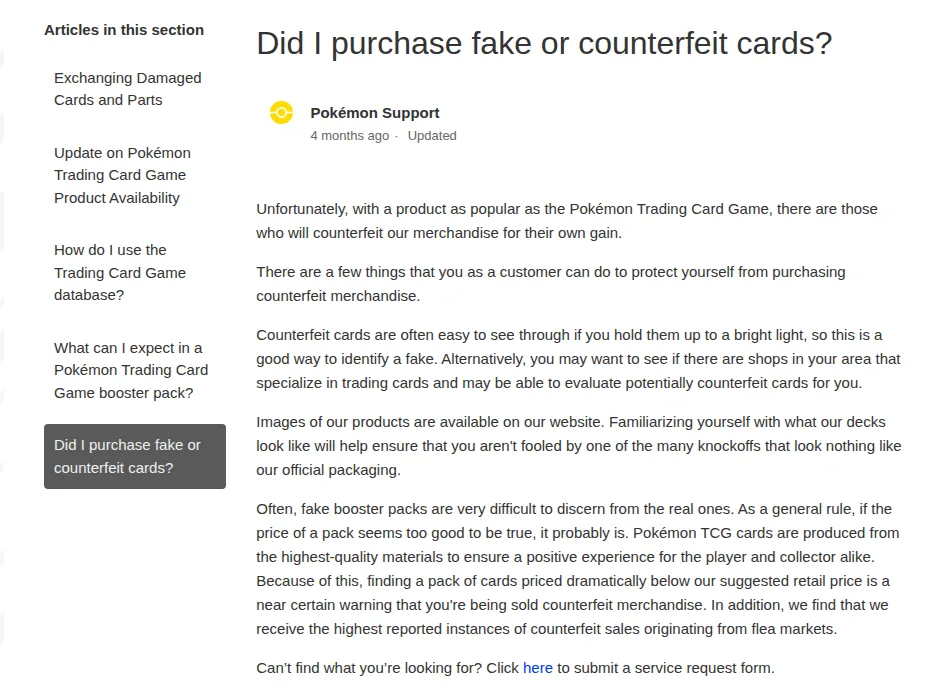 Screenshot: Pokémon Support, support.pokemon.com, October 9, 2026
Some fakes are obvious. In a thread on r/pokemoncardcollectors, a parent asked whether their daughter's shiny new cards were real, and the replies were quick:
The comment reads: "All real Pokemon cards have a blue back and even those are faked, these holo and gold backed cards are the easiest immediate tell they're not authentic Pokemon cards." Another reply had a kinder take: "They are fakes and if she knows it and she still enjoys them, it's not a waste of money." The harder cases are fakes that copy a real card closely, and that is where the checks below matter.
Step-by-Step: how to spot fake Pokemon cards in 8 checks
You need the official scan of the same card, good light, a ruler and ideally a genuine card from the same era. The Wargamer guide to fake Pokémon cards puts it first for a reason: "the most important requirement for all these tests is that you compare your potential fake against a real copy of the pokémon card in question."
1. Find the official scan. Look up the exact card, set and number. Pokémon's support site notes that "images of our products are available on our website," and Wargamer suggests checking "against a card scan from pokemon's official database" if you don't own a genuine copy.
2. Check the back. This is the fastest tell. Wargamer says you are "almost certainly looking at a fake if the diagonal sweep of light blue colour immediately to the top-right of the pokéball" is "a solid, light, or 'washed-out' blue colour." On a real card it is dappled with darker blue.
3. Check the fonts and spelling. Compare the name, HP, attack text and the é in Pokémon with the scan. Wargamer: "make sure all the fonts used are consistent with the ones on a real card," because "fakes may have user different fonts in various spots."
4. Check the energy symbols. "On fake cards, the small, circular energy symbols are often the wrong size or design, or in the wrong position." Look at the attack cost icons and the weakness and retreat icons too.
5. Find the copyright line. "Genuine pokémon cards have their print year and copyright printed at the bottom of the card." If it is missing entirely, the card is very likely fake.
6. Measure it. A real card is "2.5 inches (63 millimeters) wide and 3.5 inches (88 millimeters) tall," and "even the best designed fakes can often slip up on the dimensions."
7. Do the light test. Pokémon's support site says counterfeit cards "are often easy to see through if you hold them up to a bright light." Shine a torch through the suspect card and a genuine one side by side. Fakes "will let through noticeably more light than the real deal."
8. Feel the finish. Real cards "tend to have a smooth, matte finish - whereas fakes tend to be glossy and shiny." This one needs a genuine card in hand to compare.
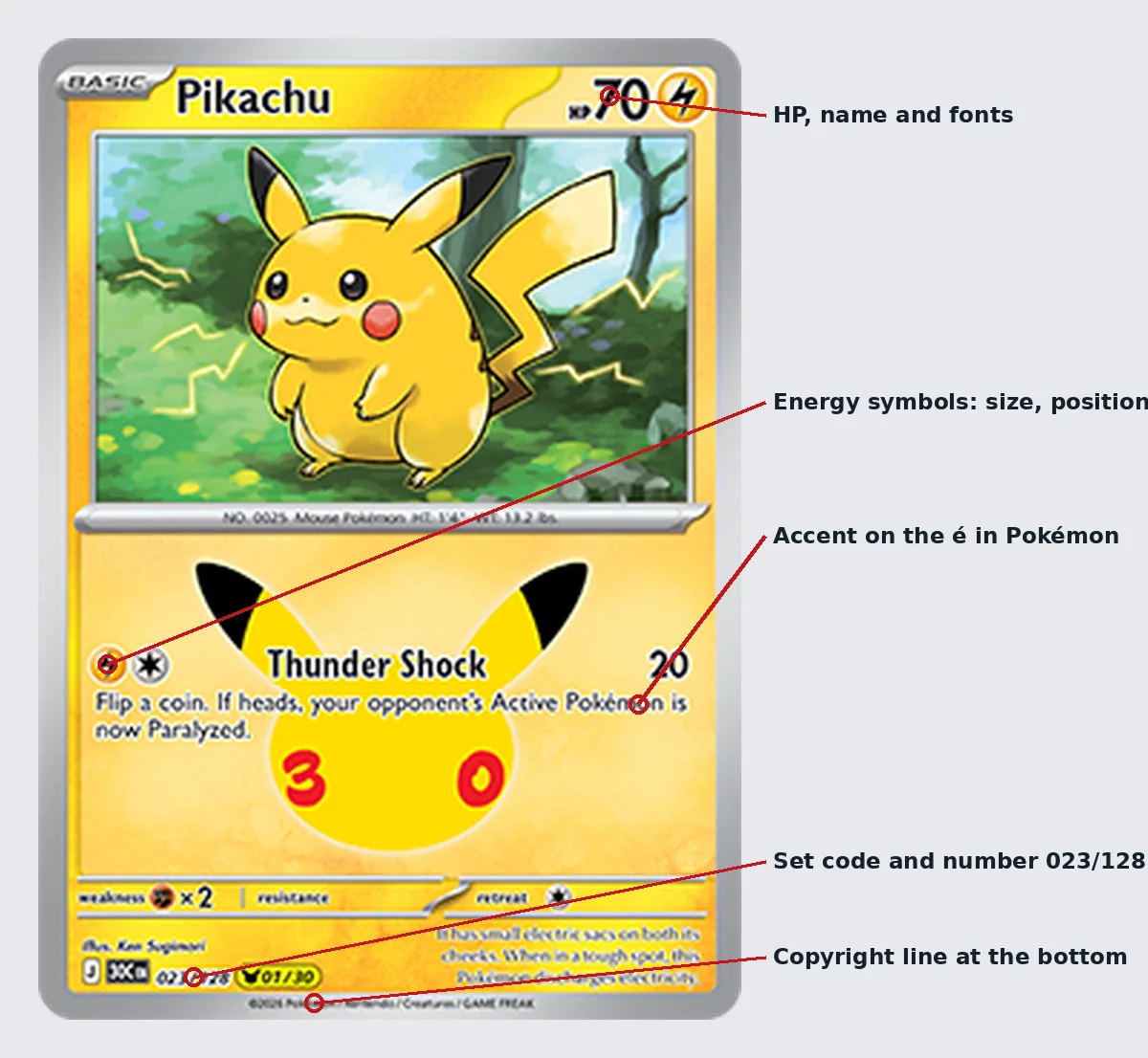 Card image: pokemon.com card database, annotated by SetPulls
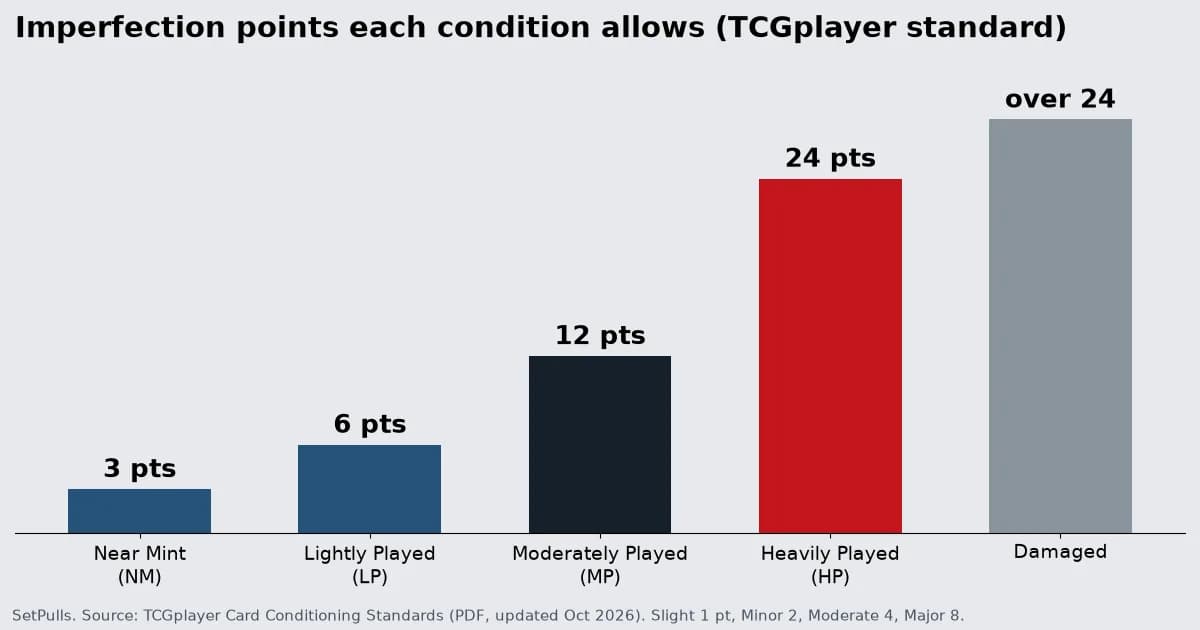
GODEEPER: Once you know a card is real, here is how to judge its condition with TCGplayer's points system. Pokemon Card Condition Guide →
Tests that are less useful than they sound
Two popular tests come with catches.
The weight test is weak. Wargamer says "authentic pokémon cards weigh between 1.8 and 2 grams," but "most modern fakes are able to get the weight about right." If a card is light enough to fail, it has usually failed something else already.
The rip test is destructive. It "requires you to tear open or peel back the corner of your card to check for the presence of that magical, authenticity-guaranteeing internal black layer." Whatever the result, the card is ruined. Use the light test instead, which looks for the same layer without tearing anything.
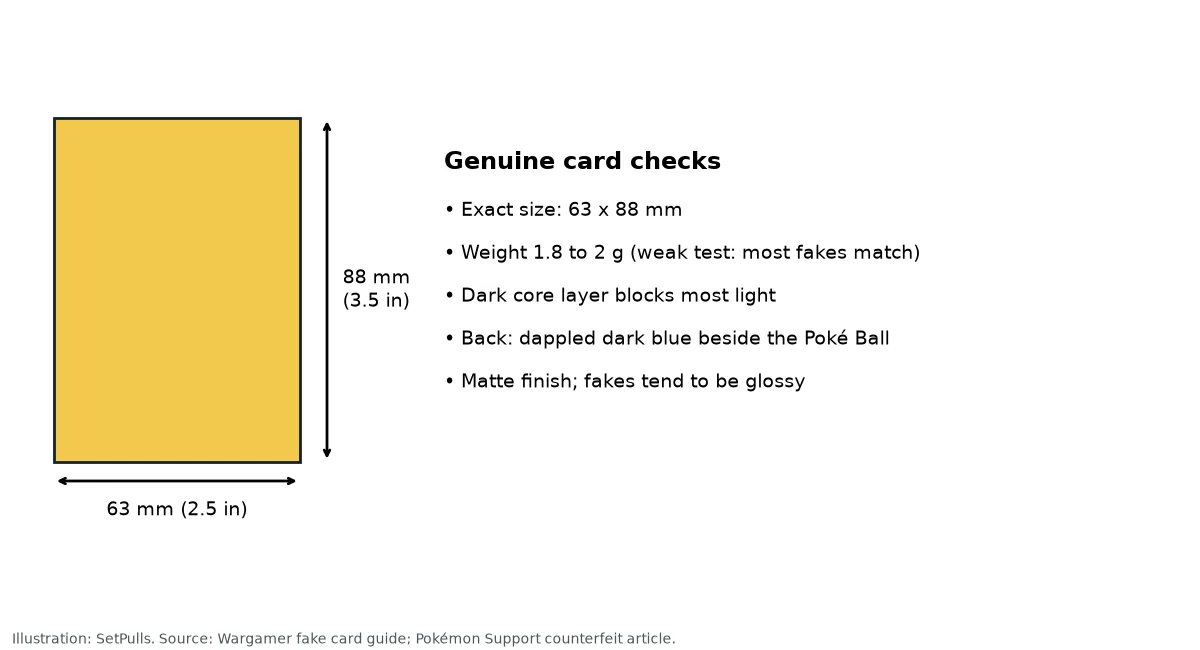 Illustration: SetPulls. Source: Wargamer fake card guide and Pokémon Support counterfeit article
Also rule out a misprint before you call a card fake. Real error cards exist, and Wargamer suggests checking "against a database of known error cards - the best one we've found is at bulbapedia."
Fake packs and fake slabs
Sealed product is harder. Pokémon's support site admits "fake booster packs are very difficult to discern from the real ones," so the price and the seller do most of the work. A pack "priced dramatically below our suggested retail price is a near certain warning that you're being sold counterfeit merchandise," and Pokémon says it receives "the highest reported instances of counterfeit sales originating from flea markets."
Know the real numbers before you shop. A 30th Celebration Elite Trainer Box has a $49.99 MSRP for nine packs, about $5.55 a pack; our 30th Celebration ETB breakdown has the full contents. Each genuine 30th Celebration pack holds five foil cards, one of them a Pikachu, plus a foil Basic Energy. A pack that opens with anything else is a problem.
Graded cards have their own checks. PSA seals every card in a "sonically sealed, tamper-evident case," and "the card's grade and certification number are displayed on the PSA LightHouse™ label." Look that number up on the grader's website and make sure the result matches the card in front of you, then check the case for signs it was opened.
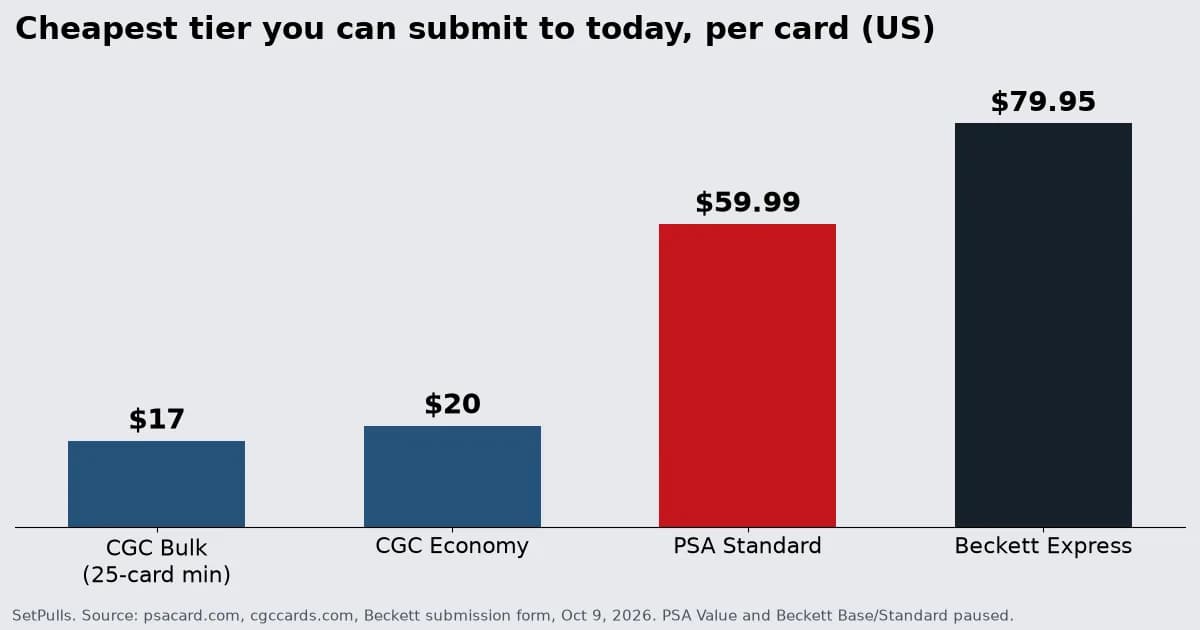
GODEEPER: What it costs to have PSA, CGC or Beckett authenticate and grade a card in 2026. PSA vs CGC vs BGS Grading Fees 2026 →
Tips: how to spot fake Pokemon cards before you buy
- Ask for the back. A photo of the back answers more than any front photo, given how many fakes fail there.
- Compare before you pay. Pull up the official scan on your phone while you look at the card.
- Use a local card shop. Pokémon itself suggests shops "that specialize in trading cards and may be able to evaluate potentially counterfeit cards for you."
- Be wary of flea market sealed product and of any pack priced well under suggested retail.
- Check the certification number on any graded card before money changes hands.
Our take
This take uses only the official advice and guides cited above. Most fakes are caught by two checks: the back and a side-by-side with the official scan. The light test is worth doing because Pokémon itself recommends it. The weight and rip tests mostly waste time or cards. Sealed packs are where people get caught, because Pokémon admits fake packs are very hard to spot by eye, so buy sealed product from sellers you trust and treat a bargain as a warning.
Frequently Asked Questions
What is the easiest way to tell if a Pokémon card is fake? Compare it with the same card on Pokémon's official card database or with a card you know is real. Start with the back, where fakes are often lighter or washed out beside the Poké Ball. Card Bazaar, quoted by Wargamer, says around 80% of counterfeits fail on the back's shade of blue.
Does the light test work for Pokémon cards? Yes, as a first check. Pokémon's support site says counterfeit cards are often easy to see through when held up to a bright light. Fakes tend to let noticeably more light through than a genuine card, which has a dark layer between two white layers of card stock.
Should I do the rip test on a Pokémon card? Only on a card you are happy to destroy. The rip test means tearing or peeling a corner to look for the black middle layer, so the card is ruined either way. The light test, the back color and a side-by-side comparison answer the same question without any damage.
How can I tell if a Pokémon booster pack is fake? It is hard. Pokémon support says fake booster packs are often very difficult to tell from real ones, so price and seller matter most. A pack priced dramatically below suggested retail is a near certain warning, and most reported counterfeit sales come from flea markets, per Pokémon.
Can a graded Pokémon card in a slab be fake? The slab and label can be faked, so check them. PSA seals every card in a sonically sealed, tamper-evident case and prints the grade and certification number on the label. Look the number up on the grading company's website and make sure the result matches the card.
Related Reading
- 30th Celebration card list and chase cards: the real card numbers and rarities to check a suspect card against.
- 30th Celebration pull rates: what a genuine pack is likely to hold.
- Pokemon card collecting guide 2026: condition, grading, storage and buying safely in one place.
References
Was this guide helpful?
About the author

Editorial desk
The SetPulls desk. Every article is built from a source file: official Pokémon TCG announcements, published card lists, and dated market data, each linked in the article.
Keep reading
Pokemon Card Condition Guide: NM, LP, MP, HP and Damaged
Guides · 12 min
Pokemon Card Collecting Guide 2026: Condition to Grading
Guides · 14 min
PSA vs CGC vs BGS Grading Fees 2026: Prices and Wait Times
Guides · 12 min

Pokemon TCG Release Dates 2026-2027: Every Official Date
Guides · 10 min

30th Celebration Pull Rates: Odds From 3,000+ Packs
Guides · 12 min

30th Celebration Elite Trainer Box: 9 Packs, MSRP, Promo
Guides · 10 min

30th Celebration Card List: All 158 Cards and Top Chases
Guides · 13 min

Pokemon TCG Products Guide 2026: ETBs, Bundles, Tins, UPCs
Guides · 14 min
Disclaimer
This article is published for informational and entertainment purposes. It does not constitute professional financial, legal, or technical advice. Game performance, online services, patch schedules, and store listings change. Verify critical details (pricing, system requirements, regional availability) with publishers and storefronts before you buy. Affiliate links, where present, help support our editorial work and are labelled in our affiliate disclosure.