Guides
Pokemon Card Rarity Symbols Explained: Every Star and Shape
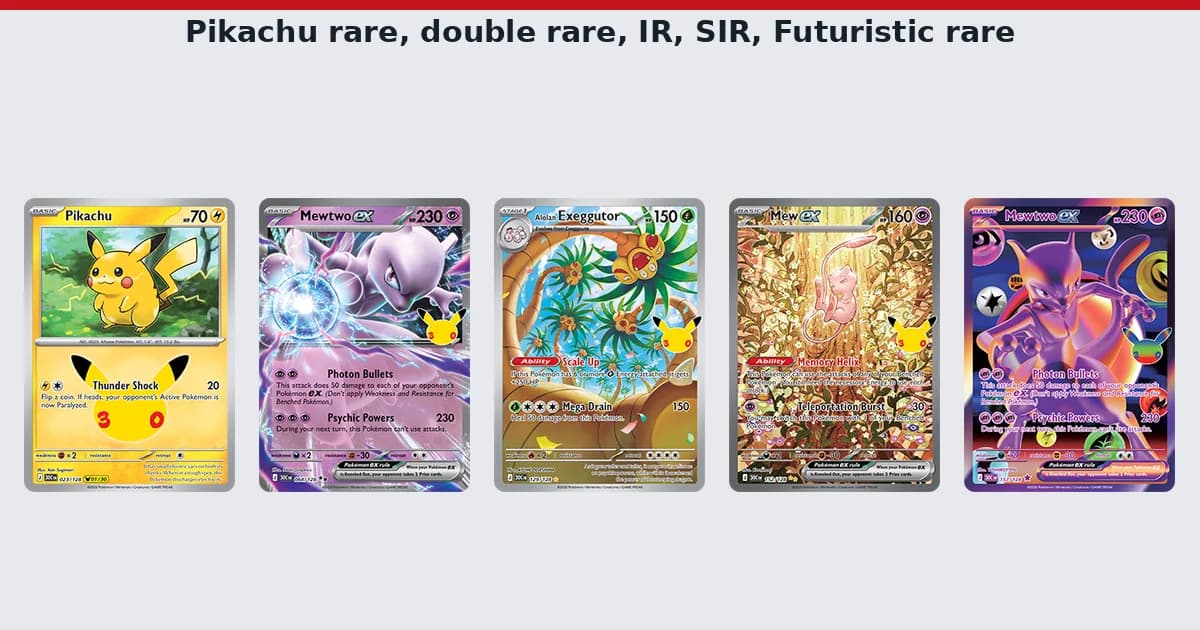
Pokemon card rarity symbols are the small shapes printed at the bottom of every card: a black circle for common, a black diamond for uncommon, a black star for rare, and a ladder of black, silver and gold stars above that. Newer sets add their own symbols on top, and 30th Celebration, the newest English set, uses a set of symbols that appears nowhere else. This guide covers what each symbol means, where to find it, and how often each one turns up in packs.
TL;DR: Circle = common, diamond = uncommon, black star = rare, two black stars = double rare, two silver stars = ultra rare, one gold star = illustration rare, two gold stars = special illustration rare, three gold stars = hyper rare, black star with PROMO = promo. Mega Evolution sets add a Mega Hyper Rare symbol and pastel two-star Mega Attack cards. 30th Celebration swaps in a Pikachu rare, a teal Futuristic rare and a ★C Classic Collection mark. The symbol tells you rarity, not price.
Pokemon card rarity symbols: the quick answer
Look at the bottom corner of the card, next to the set code and card number. The shape and its color give the rarity. Black shapes (circle, diamond, star, two stars) are the regular rarities, two silver stars mean ultra rare, and gold stars mark the illustration and hyper rare tiers that most collectors chase.
Key Takeaways
- Four universal symbols: black circle (common), black diamond (uncommon), black star (rare), black star with "PROMO" (promo), per CGC.
- Five Scarlet & Violet additions: two black stars (double rare), two silver stars (ultra rare), one gold star (illustration rare), two gold stars (special illustration rare), three gold stars (hyper rare).
- Mega Evolution extras: a Mega Hyper Rare symbol (pull rates as low as 1 in 1,260 packs) and, since Ascended Heroes in January 2026, two pastel stars for Mega Attack cards.
- 30th Celebration is different: the official card list adds a Pikachu rare, a teal-star Futuristic rare and a ★C Classic Collection mark, and has no uncommons.
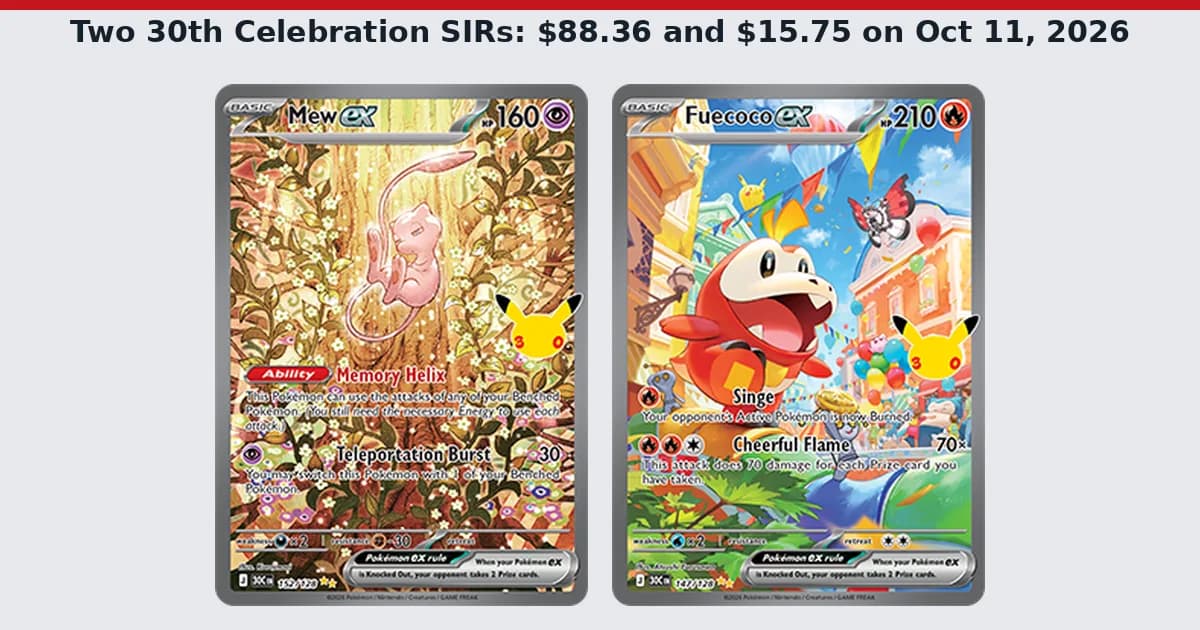
- Same symbol, different price: two 30th Celebration special illustration rares sold for $88.36 and $15.75 on October 11, 2026.
Overview: where the rarity symbol sits on a card
Reading Pokemon card rarity symbols starts with finding them. On current cards the rarity symbol is in the bottom left corner, beside the three-letter set code and the collector number. Older cards put it on the right. If a guide tells you "lower right" and your card shows it on the left, both are describing real cards from different eras.
That mismatch shows up in official material too. Pokémon's own help article on the card database says "The rarity symbol is found in the lower-right corner of the card," and that the official Pokémon TCG card database can filter by it. CGC, the grading company, covers both layouts: "Every Pokémon card is marked with a small symbol in either the bottom right or bottom left-hand corner, adjacent to the set number." Dexerto's symbol guide, written around current Scarlet & Violet and Mega Evolution cards, puts it plainly: "These rarity symbols are stamped in the bottom left of your Pokemon cards."
The collector number next to the symbol is the second clue. A number higher than the set total, such as 152/128 for 30th Celebration's Mew ex, means the card is one of the extra rares counted above the base set. Dexerto's example is a gold Roaring Moon ex numbered "#262 out of a base set of 182."
The standard Pokemon card rarity symbols
Nine symbols cover almost every English card from Scarlet & Violet onward. CGC lists four as universal and five as the additions The Pokémon Company made "to eliminate some confusion between official rarities and 'fan-dubbed' rarities" that collectors had been using.
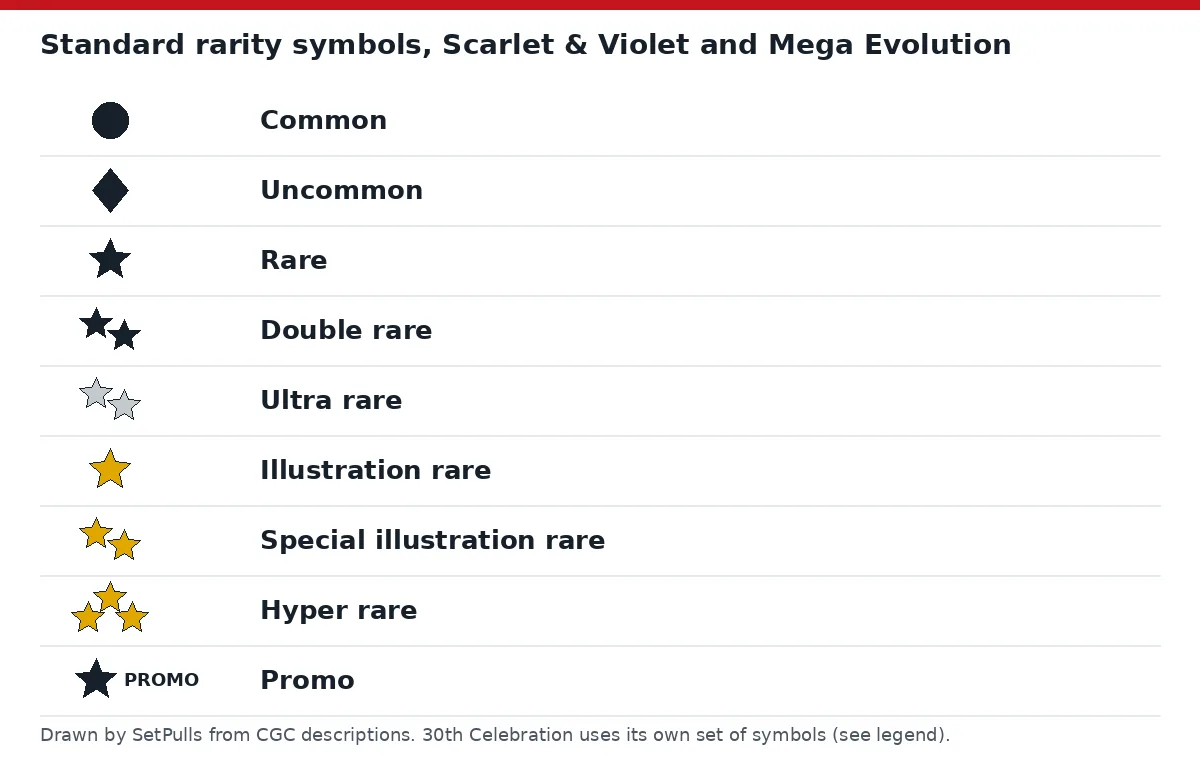 Source: cgccards.com rarity symbol guide. Drawing: SetPulls.
| Symbol | Rarity | Notes |
|---|---|---|
| Black circle | Common | Most cards in a regular pack |
| Black diamond | Uncommon | Usually evolved Pokémon and Trainers |
| Black star | Rare | At least one rare or higher per regular pack |
| Two black stars | Double rare | Almost always a Pokémon ex; Japanese RR |
| Two silver (white) stars | Ultra rare | Closest Japanese rarity: Super Rare (SR) |
| One gold star | Illustration rare | Closest Japanese rarity: Art Rare (AR) |
| Two gold stars | Special illustration rare | Numbered above the set total in 30th Celebration |
| Three gold stars | Hyper rare | Gold cards; top of the Scarlet & Violet ladder |
| Black star with "PROMO" | Promo | Not pulled from booster packs |
Pokémon's help center describes a regular English booster pack as "10 game cards: 4 commons, 3 uncommons, and 3 foils (at least one of which will be rare or higher)." That is why your stack of circles and diamonds grows much faster than your stars.
Japanese cards print letter codes instead of English stars, and the match between the two is approximate: Dexerto calls the Japanese RR the same "Double Rare" tier, but for ultra rares and illustration rares it only names the "closest" Japanese rarity (SR and AR).
Gold and colored stars in Mega Evolution sets
The Mega Evolution series kept the Scarlet & Violet symbols and added more. CGC says Mega Evolution "introduced a new card rarity", Mega Hyper Rares: gold-finish cards of Mega Evolved Pokémon with their own symbol, at "pull rates as low as 1 in 1,260 packs." When Ascended Heroes released in January 2026, Mega Attack cards arrived with "a rarity symbol consisting of two pastel-colored stars, one pink and one green."
That new gold symbol confuses people who learned the three-star hyper rare. When a collector asked on r/PokemonTCG whether gold cards had their own rarity symbol, u/splatex136 answered: "Yes they are called officially 'mega hyper rare' for the megas and only 'hyper rare' for regular golds from SV era."
30th Celebration's own rarity symbols
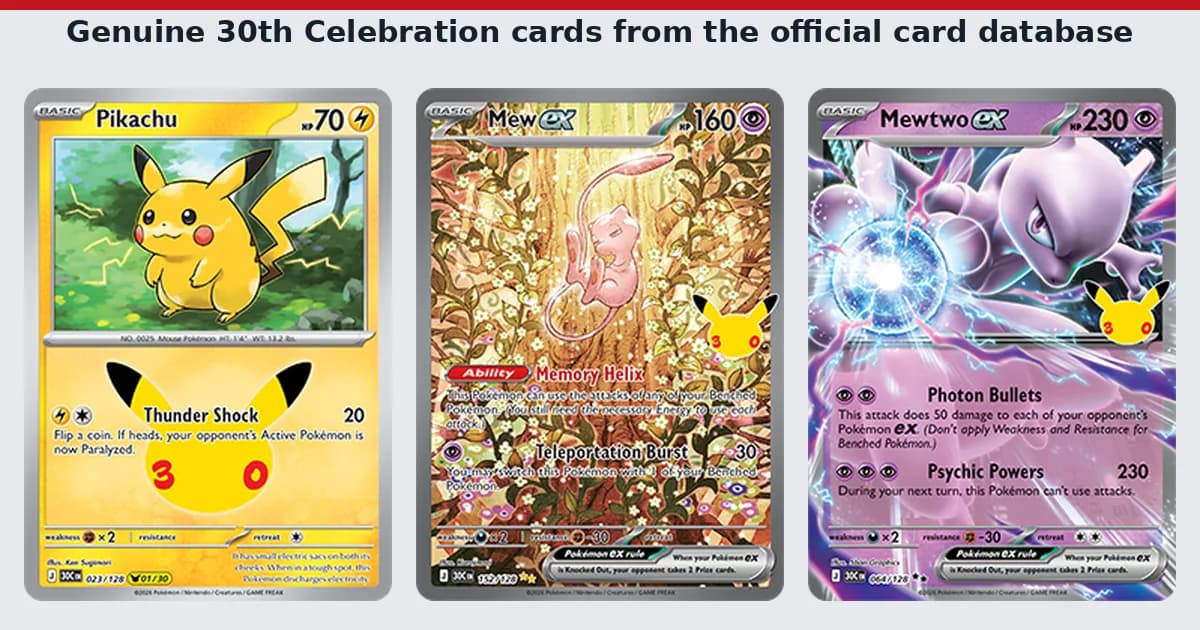
30th Celebration does not use the standard ladder. The official 30th Celebration card list prints its own legend: standard set foil, common, rare, double rare, illustration rare, special illustration rare, Pikachu rare, Futuristic rare and Classic Collection. There is no diamond on the list because the set has no uncommons.
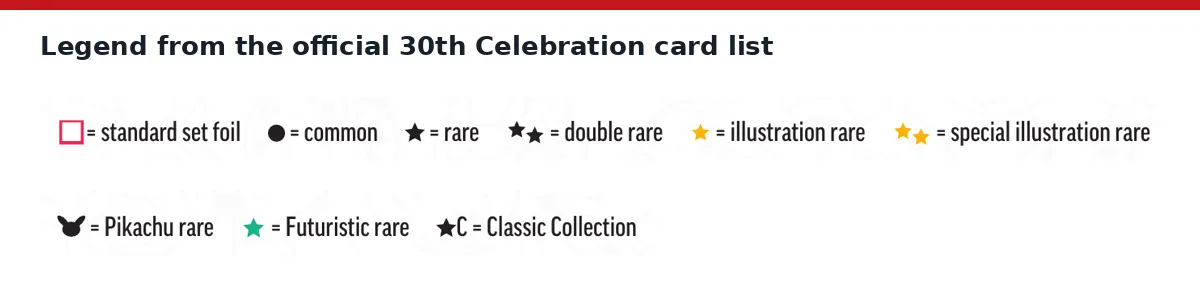 Source: official 30th Celebration card list (pokemon.com). Crop: SetPulls.
The new marks map to the set's three gimmicks. Each pack holds "five foil cards (including one of 30 unique illustrations of pikachu) and one foil basic energy card," so the Pikachu-head symbol is on one card in every pack. The set also reprints "30 iconic cards from the classic collection," marked with a star and the letter C, and has "two dazzling futuristic rare cards by artist yoshirotten," marked with a teal star.
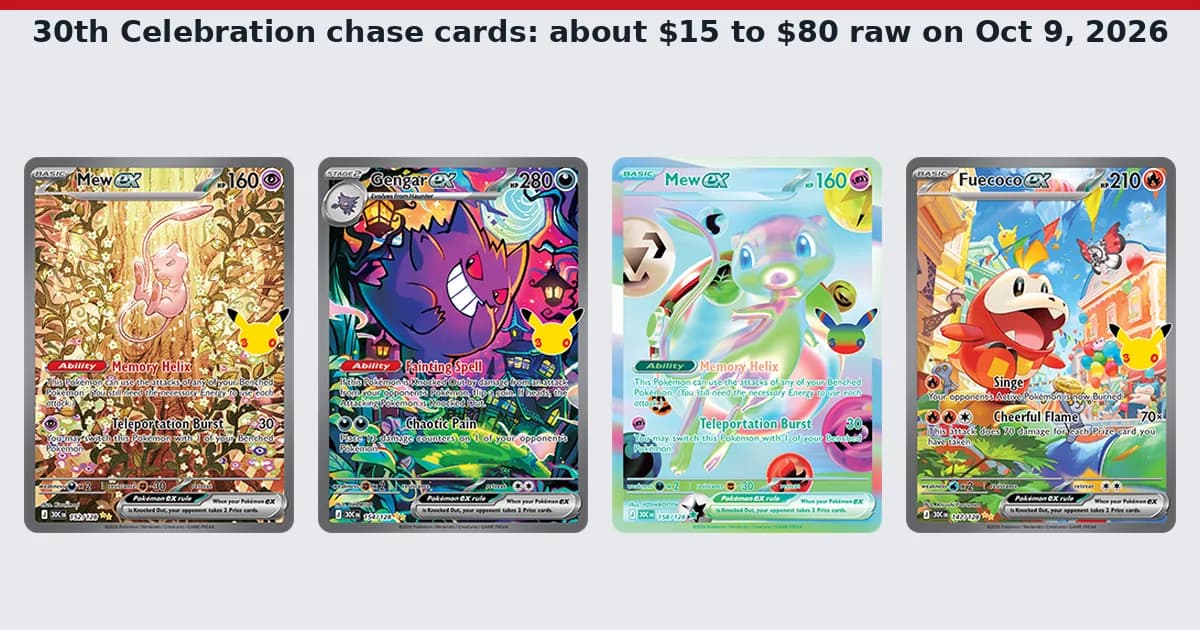
Counting the checklist line by line gives 12 double rares, 18 illustration rares (numbers 129 to 146), 10 special illustration rares (147 to 156) and 2 Futuristic rares (157 and 158). Our 30th Celebration card list has every card with its number and symbol.
How rare each symbol is in packs
Pokemon card rarity symbols rank cards inside a set, but the odds behind them differ from set to set, and Pokémon does not publish them. Its help center says Pokémon is "unable to guarantee a specific pokémon or type of card (pokémon ex, prism star, etc.) in any specific booster pack." For 30th Celebration the best public numbers come from TCGplayer's Authentication Center, which opened more than 3,000 English packs.
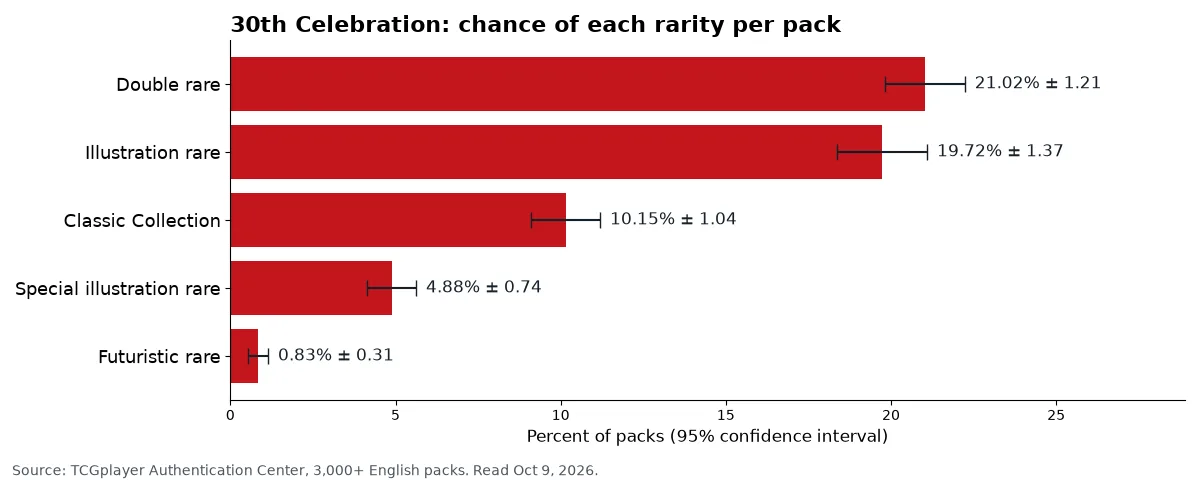 Source: TCGplayer Authentication Center, 3,000+ English packs. Chart: SetPulls.
| Symbol (30th Celebration) | Chance per pack | About |
|---|---|---|
| Two black stars (double rare) | 21.02% ± 1.21% | 1 in 5 |
| One gold star (illustration rare) | 19.72% ± 1.37% | 1 in 5 |
| ★C (Classic Collection) | 10.15% ± 1.04% | 1 in 10 |
| Two gold stars (special illustration rare) | 4.88% ± 0.74% | 1 in 21 |
| Teal star (Futuristic rare) | 0.83% ± 0.31% | 1 in 120 |
| Pikachu head (Pikachu rare) | every pack | guaranteed last slot |
Those rates are generous by Mega Evolution standards. TCGplayer notes that "most mega evolution series sets have pull rates of 1:9 for illustration rares and in 1:80" for special illustration rares, against 1 in 5 and 1 in 21 here. So a gold star means the same tier in every set, but how hard it is to pull depends on the set.
GODEEPER: Slot-by-slot odds, four independent opening counts and the chance of each hit per product. 30th Celebration Pull Rates →
Step-by-Step: how to read Pokemon card rarity symbols on any card
Six checks, in order, settle the rarity of almost any English card.
1. Find the bottom corner. Turn the card face up and look at the bottom edge. On Scarlet & Violet and Mega Evolution cards the symbol is bottom left, beside the set code and collector number; on older cards check bottom right.
2. Read the shape. Circle, diamond and one black star are common, uncommon and rare. Two stars of any color mean a double rare or higher.
3. Read the color. Black stars are double rare, silver or white stars are ultra rare, and gold stars are the illustration rare, special illustration rare and hyper rare tiers. Pastel pink and green stars are Mega Attack cards.
4. Compare the collector number with the set total. A number above the printed total, such as 152/128, puts the card in the extra rares counted after the main set.
5. Look for PROMO or a set-specific mark. A black star with text is a promo. On 30th Celebration, a Pikachu head, a teal star or a ★C mean Pikachu rare, Futuristic rare and Classic Collection.
6. Confirm in the official card database. Search the card in Pokémon's official card database, which can filter by rarity, and compare the symbol, number and art with your copy.
Tips: what rarity symbols don't tell you
- No symbol at all. Some special releases skip it. In one thread a parent asked why a new card had no symbol; u/TheShinyHunter3 replied "It's from the 2022 McDonald mini set." and another collector added that it is "Considered promo." Misprints happen too, so check the database before assuming anything.
- Don't read value off the symbol. CGC says "It is impossible to determine a rare card's value just by checking the rarity symbol," and Pokémon's help center says the company "does not maintain or track any information on the secondary market value of our products." On October 11, 2026, TCGplayer's market price was $88.36 for Mew ex 152/128 and $15.75 for Fuecoco ex 147/128, both special illustration rares with two gold stars, about 5.6 times apart.
- Gold stars draw fakes. Dexerto notes hyper rares are "commonly faked by counterfeit sellers online", so a shiny gold card from an unknown seller needs more than a correct symbol.
- Don't mix EN and JP labels. A Japanese "SR" or "AR" is not printed as stars, and the matches to English tiers are approximate.
GODEEPER: Eight physical checks for fakes, from the font and energy symbols to the light test. How to Spot Fake Pokemon Cards →
Our take
Based on the cited facts above: learn the nine standard Pokemon card rarity symbols once and you can sort any recent English set, but check the set's own legend before you trust the ladder. 30th Celebration proves that a set can drop uncommons and add three marks of its own, and the Mega Evolution gold symbols show the ladder still grows. Price the card on its own: the same two gold stars covered an $88.36 card and a $15.75 card on the same day.
Frequently Asked Questions
What do the symbols on Pokemon cards mean for rarity? A black circle is common, a black diamond uncommon and a black star rare. Since Scarlet & Violet, two black stars mean double rare, two silver stars ultra rare, one gold star illustration rare, two gold stars special illustration rare and three gold stars hyper rare.
Where is the rarity symbol on a Pokemon card? At the bottom, next to the set code and collector number. CGC says it can sit in the bottom right or bottom left corner. Current Scarlet & Violet and Mega Evolution cards put it bottom left, while Pokémon's older help article still says the lower right.
What does a gold star mean on a Pokemon card? One gold star is an illustration rare, two gold stars a special illustration rare and three gold stars a hyper rare. Mega Evolution sets also have a separate Mega Hyper Rare symbol for gold-finish Mega cards, which CGC says pull as rarely as 1 in 1,260 packs.
What does a black star with PROMO mean? It marks a promo card. Promos are not pulled from regular booster packs: they are handed out at events or packed into boxed products as box toppers. A black star with text means promo, not a rare from the set, even when the artwork looks special.
Why does my Pokemon card have no rarity symbol? Some special releases skip it. In an r/PokemonTCG thread, collectors identified a symbol-less card as part of the 2022 McDonald's mini set and called it a promo. Misprints exist too, so compare the card's number and art with its entry in Pokémon's official card database.
Does the rarity symbol tell you what a card is worth? No. CGC says value cannot be judged from the symbol alone, and Pokémon does not track resale prices. Two 30th Celebration special illustration rares with the same two gold stars had TCGplayer market prices of $88.36 and $15.75 on October 11, 2026.
Related Reading
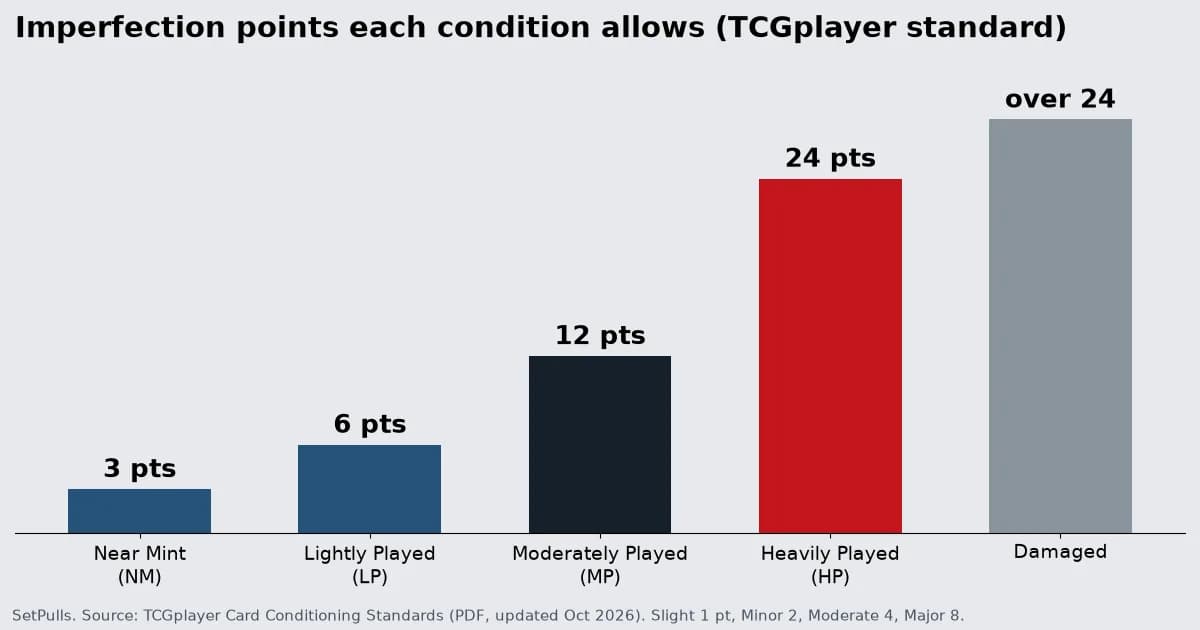
- Pokemon Card Condition Guide: once you know a card is rare, its condition decides most of its value.
- PSA vs CGC vs BGS Grading Fees 2026: what it costs to grade the gold-star cards worth grading.
- Pokemon Card Collecting Guide 2026: condition, grading, storage, fakes and values in one place.
- Pokemon TCG Sets Complete Guide 2026: every English Mega Evolution set with release dates and card counts.
References
- Pokémon Support: How do I use the Trading Card Game database?
- Pokémon Support: What can I expect in a booster pack?
- Pokémon Support: What are my cards worth?
- Official 30th Celebration card list (PDF)
- Pokémon: 30th Celebration product showcase
- Pokémon: 30th Celebration expansion page
- CGC: Understanding Pokémon Rarity Symbols and Card Features
- Dexerto: Pokemon TCG card symbols explained
- TCGplayer: 30th Celebration pull rates
- r/PokemonTCG: Do gold cards have their own rarity symbol?
Was this guide helpful?
About the author

Editorial desk
The SetPulls desk. Every article is built from a source file: official Pokémon TCG announcements, published card lists, and dated market data, each linked in the article.
Keep reading
How to Sell Pokemon Cards: TCGplayer vs eBay Fees (2026)
Guides · 12 min

How to Store Pokemon Cards: Sleeves, Toploaders, Binders
Guides · 12 min
Pokemon Card Collecting Guide 2026: Condition to Grading
Guides · 15 min
How to Spot Fake Pokemon Cards: 8 Checks That Still Work
Guides · 10 min
Pokemon Card Condition Guide: NM, LP, MP, HP and Damaged
Guides · 12 min
PSA vs CGC vs BGS Grading Fees 2026: Prices and Wait Times
Guides · 12 min

Pokemon TCG Release Dates 2026-2027: Every Official Date
Guides · 10 min
30th Celebration Pull Rates: Odds From 3,000+ Packs
Guides · 13 min
Disclaimer
This article is published for informational and entertainment purposes. It does not constitute professional financial, legal, or technical advice. Prices, release dates and store listings change. Verify critical details (pricing, product contents, regional availability) with the retailer before you buy. Affiliate links, where present, help support our editorial work and are labelled in our affiliate disclosure.