Guides
Pokemon Card Condition Guide: NM, LP, MP, HP and Damaged
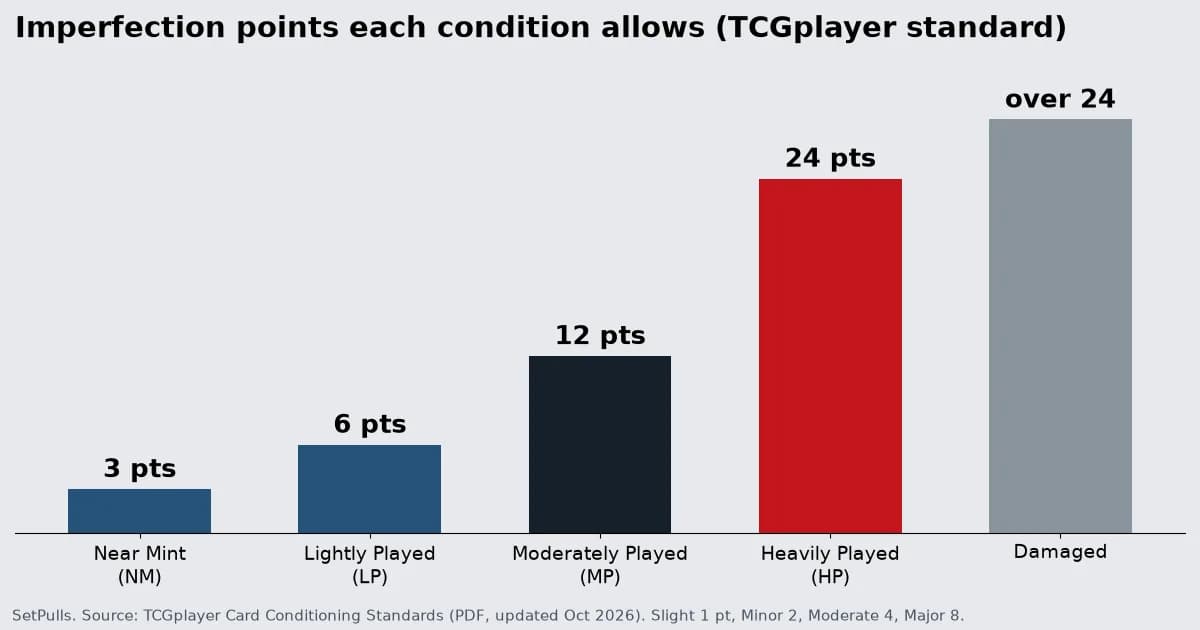
Pokemon card condition can be measured with a ruler. TCGplayer's published standard scores every flaw from 1 to 8 points and caps each condition: Near Mint allows 3 points, Lightly Played 6, Moderately Played 12 and Heavily Played 24. This guide walks through measuring a card yourself with that system, using TCGplayer's own published standards.
TL;DR: Each flaw is Slight (1 point), Minor (2), Moderate (4) or Major (8). Near Mint allows 3 points, LP 6, MP 12, HP 24; more is Damaged. Some flaws cap a card regardless of points: any whitening rules out NM, a crease means MP at best, and centering past 70/30 is a defect. Measure in millimeters, add up the points, then take the lowest cap.
How do you tell a Pokemon card condition? (quick answer)
Look at the card under bright light, find each flaw, and measure it. Edgewear is measured by length along the edge, surface flaws by area, and bends by length. Each flaw gets a severity worth 1, 2, 4 or 8 points. Add them up and compare against the limits: 3 for Near Mint, 6 for Lightly Played, 12 for Moderately Played and 24 for Heavily Played. Then check whether any single flaw caps the card lower.
Key Takeaways
- Points decide the grade: NM up to 3, LP up to 6, MP up to 12, HP up to 24, Damaged above that.
- Some flaws are never Near Mint: surface wear (whitening), grime, any bend, faults and damage.
- Edgewear is measured in length: up to 20 mm is still NM; over 160 mm is HP at best.
- A crease is MP at best, but not automatically Damaged.
- Centering up to 70/30 is fine on TCGplayer; graders want 55/45 or better for a 10.
Overview: what NM, LP, MP and HP mean
Raw Pokémon cards are bought and sold in five conditions. TCGplayer's Card Conditioning Overview lets sellers list "Near Mint, Lightly Played, Moderately Played, Heavily Played, and Damaged" cards, and adds that "Mint or Gem Mint cards are not sold on TCGplayer." Mint and Gem Mint are grading-company labels. They don't apply to a raw card.
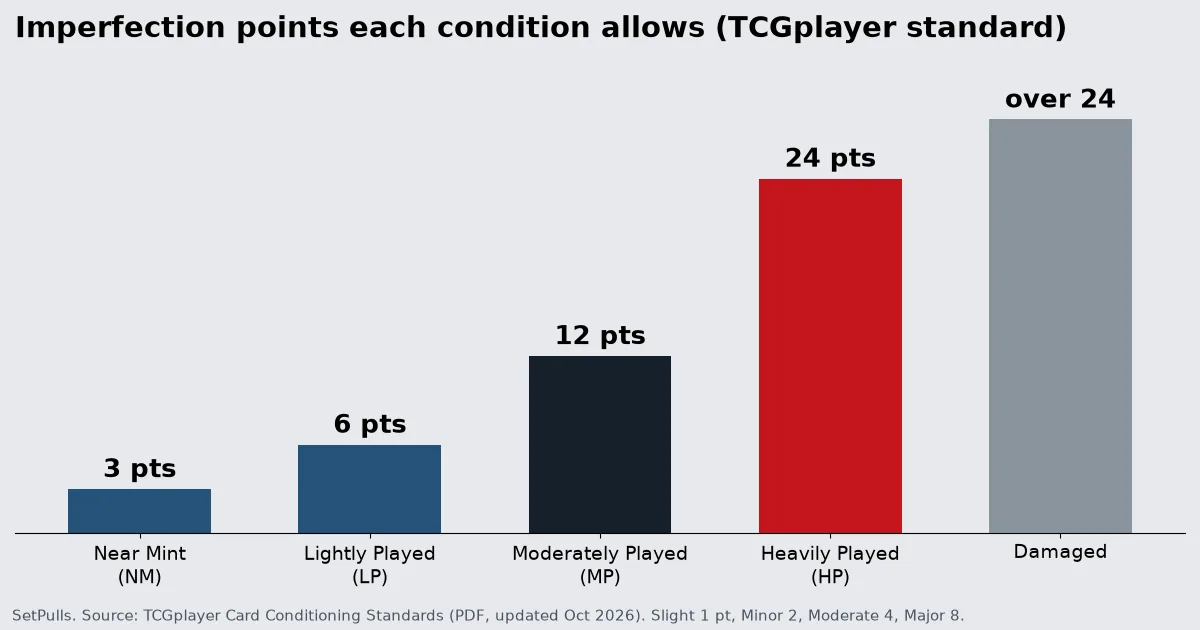 Chart: SetPulls. Source: TCGplayer Card Conditioning Standards (PDF), updated October 2026
The short definitions give the feel of each grade. Near Mint cards "show minimal wear from shuffling, play, or handling and can have a nearly unmarked surface, crisp corners, and unblemished edges." Lightly Played "shows signs of handling or play, but does not display significant imperfections." Moderately Played "shows significant play, use or wear," and Heavily Played "shows significant wear and imperfections." Even an HP card "must still be able to be authenticated and cannot be structurally damaged."
Those one-liners are not the full standard, a point collectors argue about. In a thread on r/pokemoncardcollectors about whether buyers have become too critical, one reply put it this way:
The comment reads: "The problem is that that definition of HP is not how you condition a card. If your read the page it says those are simplified definitions." The full rules live in TCGplayer's Card Conditioning Standards PDF and its comprehensive imperfections guide, and that is what the steps below use.
The points system behind each Pokemon card condition
Every flaw has a type and a severity. Severity is worth points: "Slight - 1 point | Minor - 2 points | Moderate - 4 points | Major - 8 points." Each condition allows a points total and a list of flaw types.
| Condition | Points allowed | Flaw types allowed | Not allowed |
|---|---|---|---|
| Near Mint (NM) | Up to 3 | Slight edgewear, slight scuffing, minor scratches, slight indentation, slight defect | Surface wear, grime, bend, fault, damage |
| Lightly Played (LP) | Up to 6 | Minor edgewear, scratches, scuffing, indent, bend and defect; slight grime; slight surface wear | Fault, damage |
| Moderately Played (MP) | Up to 12 | Moderate edgewear, scratches, scuffing, indent; minor surface wear, grime, bends, faults, defects | Damage |
| Heavily Played (HP) | Up to 24 | Major edgewear, scratches, scuffing, grime; moderate surface wear, bends, indentations, defects; minor fault | Damage |
| Damaged | Over 24 | Anything beyond HP |
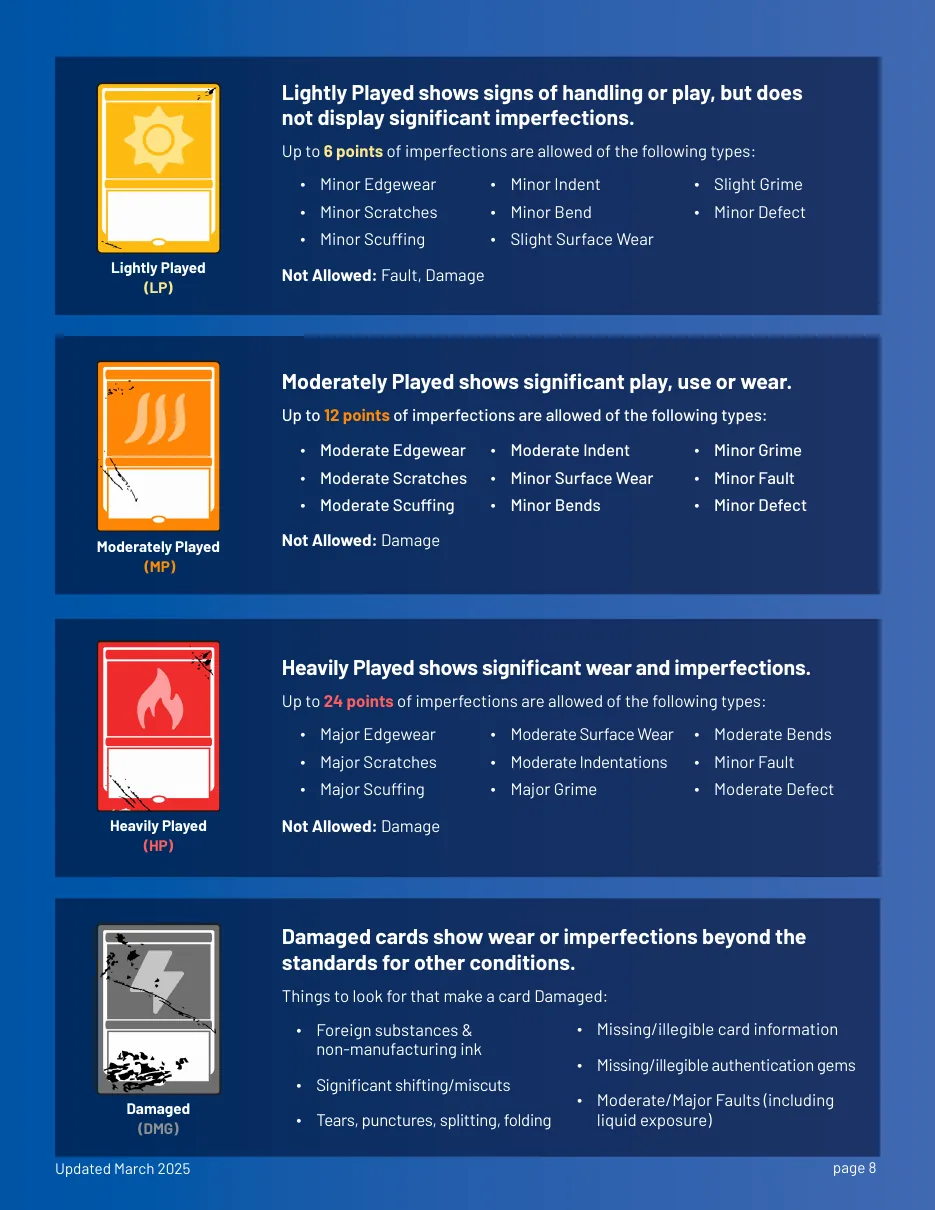 Image: TCGplayer Card Conditioning Standards PDF, page 8
For any Pokemon card condition, two rules work together. The points total sets the ceiling, and the flaw type can cap a card lower. A card with only 2 points but a slight spot of whitening is not Near Mint, because surface wear is on Near Mint's not-allowed list.
GODEEPER: Where condition fits in the bigger picture of collecting, from pulls to grading and storage. Pokemon Card Collecting Guide 2026 →
Step-by-Step: grade your own Pokemon card condition
You need bright light, a flat surface and a ruler marked in millimeters. Take the card out of its sleeve so the sleeve's own scratches don't fool you.
1. Check the card is real and unaltered. A card that cannot be authenticated is outside the scale entirely. Alterations count too: "stamps, signatures, paint, marker, etc. are also considered Damaged." If you have any doubt about the card itself, run through how to spot fake Pokemon cards first.
2. Check centering. Compare the left and right borders, then top and bottom. TCGplayer's standard says a card "may have up to 70 / 30 centering without any impact on its condition." Past that it is a defect, and the card should be listed with a photo.
3. Measure edgewear. Edgewear is lost color, gloss or material along the edges and corners. Measure each stretch; gaps under 5 mm count as one stretch. Up to 20 mm is Slight and still allowed at Near Mint. Over 20 mm up to 80 mm is Minor (LP at best), up to 160 mm is Moderate (MP at best), and anything longer is Major (HP at best).
4. Look for whitening that reaches inward. Wear that goes more than 0.5 mm in from the edge is no longer edgewear. TCGplayer's guide says "any edgewear that measures .5mm inwards from the edge is classified as Surface Wear," and "Slight Surface Wear is not allowable at Near Mint."
5. Tilt the surface under light. Check the front and back for scratches, scuffing, indents and grime. A slight scratch, "up to 20mm in length," is "allowable in all conditions." Scuffing that covers a whole side is MP at best. One pinpoint dent is still Near Mint, but a straight-line indent is "not acceptable at Near Mint."
6. Lay the card flat for bends and curl. Any bend rules out Near Mint. A minor bend is "no longer than 10mm and cannot have a crease," which keeps LP possible. "The presence of a crease drops the condition to Moderately Played at best," and a bend over 20 mm is HP at best. Curl is fine up to a 5 mm flex; more is Damaged.
7. Add up the points and take the lowest cap. Total the points from steps 3 to 6 and find the highest condition whose limit you are under. Then check each flaw's own cap. The card's condition is the lower of the two.
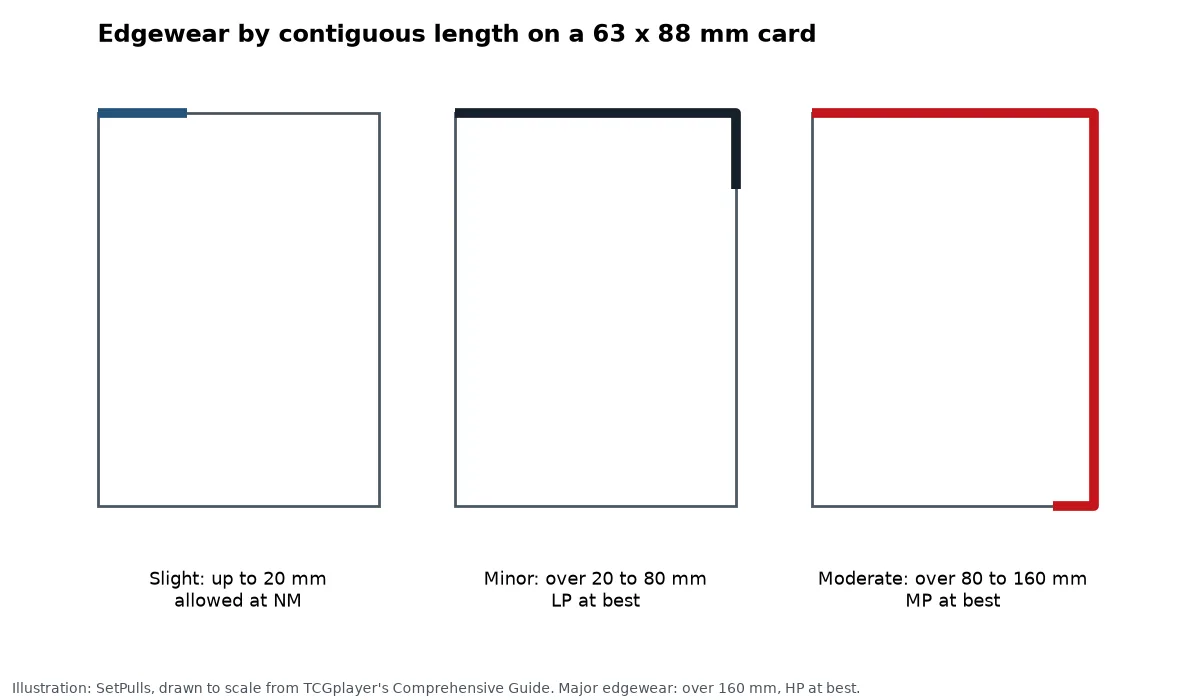 Illustration: SetPulls, drawn to scale from TCGplayer's comprehensive guide (Source: TCGplayer help center)
A worked example
Take a card with two flaws: a 15 mm nick of edgewear on one side (Slight, 1 point) and one 30 mm scratch on the back (Minor, 2 points). That is 3 points, every flaw type is on the Near Mint list, so it is Near Mint.
Now add a small white dot where the corner wear reaches more than 0.5 mm into the card. That is Slight Surface Wear, 1 more point. The total is 4, which is over the Near Mint limit anyway, and surface wear is not allowed at Near Mint. The card is Lightly Played.
The same card with a short crease instead of the dot would be Moderately Played at best, no matter how clean the rest of it looks.
Collectors don't always agree on where creases land. In the same r/pokemoncardcollectors thread, another reply said: "The card has a major crease so it's technically damaged." Under TCGplayer's written standard, a crease alone caps a card at MP or HP, and only a bend that affects the card's structure makes it Damaged.
Centering: TCGplayer vs PSA and CGC
Centering matters far more to graders than to the raw market. TCGplayer allows up to 70/30. PSA's grading standards say a Gem Mint 10 must be centered "within a tolerance not to exceed approximately 55/45 percent on the front, and 75/25 percent on the" back. CGC's Pristine 10 asks for more: "the centering is 50/50."
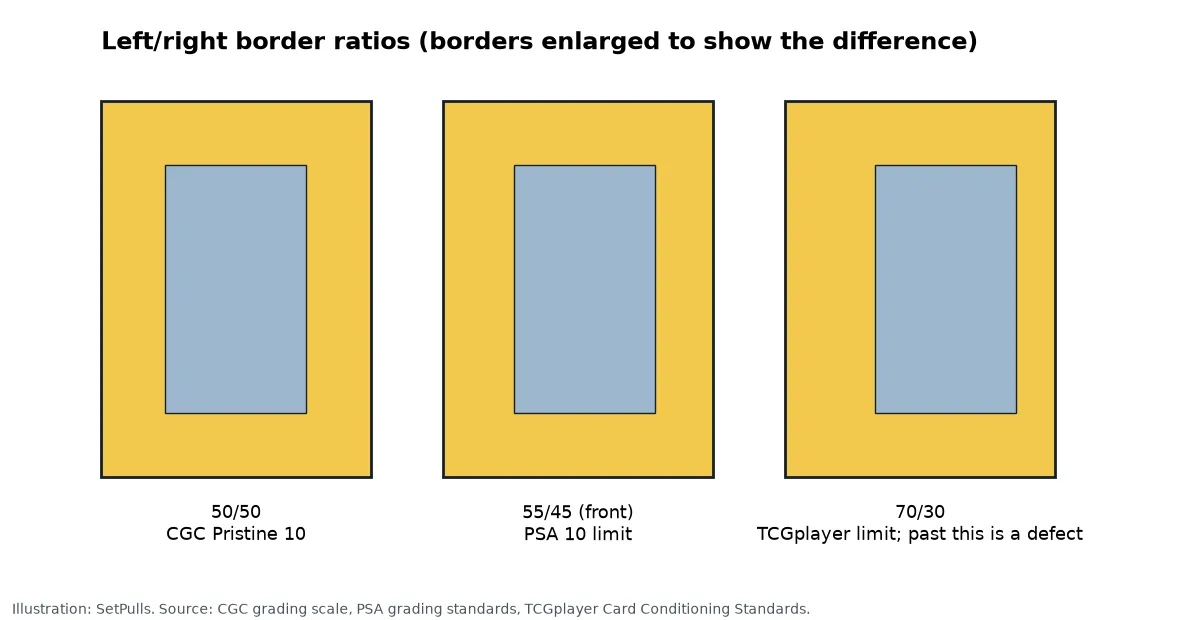 Illustration: SetPulls. Source: CGC grading scale, PSA grading standards and TCGplayer Card Conditioning Standards
So a 65/35 card can be a perfectly good Near Mint raw card and still have no chance at a PSA 10. Check Pokemon card condition and centering before you pay a grading fee.
GODEEPER: What PSA, CGC and Beckett charge per card right now, and how long each takes. PSA vs CGC vs BGS Grading Fees 2026 →
Tips for buying and selling by condition
- Grade from the back too. Flaws on both sides count, and scuffing limits are even set per side.
- Remove the sleeve first. Scratches on a sleeve look like scratches on the card.
- Photograph flaws when you sell. Defects and alterations are meant to go in a listing with a photo, so buyers can see exactly what they get.
- Pack damage has a short window. Pokémon support only helps with products "released within the last year," wants contact "within 10 business days of the original purchase date," and replaces whole booster packs only when "more than half of the cards contained must be affected by manufacturing damage."
- Minor flaws from the factory are not covered. Pokémon support says "cards with minor scratching or printing defects do not qualify for exchange," and it is "unable to replace cards that have been ruined or damaged by outside events."
Our take
This take is based on TCGplayer's published standards and the other sources cited above. The points system is the most useful thing a collector can learn, because it turns "looks NM to me" into something two people can check with a ruler. Most arguments come from mixing the short definitions with the full standard, or from treating every crease as Damaged. Measure, count the points, and name the flaws in your listing; you will get fewer disputes in both directions.
Frequently Asked Questions
What is the difference between Near Mint and Lightly Played? Near Mint allows up to 3 points of small flaws such as slight edgewear, slight scuffing or minor scratches. Lightly Played allows 6 points and adds minor bends, slight grime and slight surface wear. Any whitening that exposes cardstock, even a small dot, rules out Near Mint under TCGplayer's standard.
Is a creased Pokémon card damaged? Not automatically. TCGplayer's comprehensive guide says a crease drops a card to Moderately Played at best, and a bend longer than 20 mm caps it at Heavily Played. A card becomes Damaged when the bend affects its structure, or when it has tears, splits or punctures.
Does off-center make a Pokémon card damaged? Only past 70/30 on TCGplayer, which allows anything up to that with no effect on condition and treats more as a defect. Grading companies are stricter at the top: a PSA 10 allows about 55/45 on the front, and a CGC Pristine 10 needs 50/50 centering.
Can I sell a Mint or Gem Mint card on TCGplayer? Not as a raw card. TCGplayer lists only Near Mint, Lightly Played, Moderately Played, Heavily Played and Damaged, and says Mint or Gem Mint cards are not sold there. Mint and Gem Mint are grading-company labels, so they only apply once a card is graded and slabbed.
Will Pokémon replace a card that came damaged in a pack? Only for manufacturing damage, within limits. Pokémon support covers products released in the last year, needs contact within 10 business days of purchase, exchanges whole packs only, and requires more than half the pack's cards to be affected. Minor scratches and printing defects do not qualify.
Related Reading
- 30th Celebration card list and chase cards: the current set's most valuable cards, where condition matters most.
- 30th Celebration Elite Trainer Box contents and MSRP: what to do when a sealed box arrives short or damaged.
- Pokemon TCG products guide 2026: every sealed product type and what it holds.
References
- TCGplayer: Card Conditioning Overview
- TCGplayer: Understanding Card Condition Imperfections, A Comprehensive Guide
- TCGplayer: Card Conditioning Standards (PDF)
- PSA: grading standards
- CGC Cards: grading scale
- Pokémon Support: exchanging damaged cards and parts
- Pokémon Support: my cards were ruined, can you replace them?
- r/pokemoncardcollectors: has the eye for raw card conditions become too critical?
Was this guide helpful?
About the author

Editorial desk
The SetPulls desk. Every article is built from a source file: official Pokémon TCG announcements, published card lists, and dated market data, each linked in the article.
Keep reading
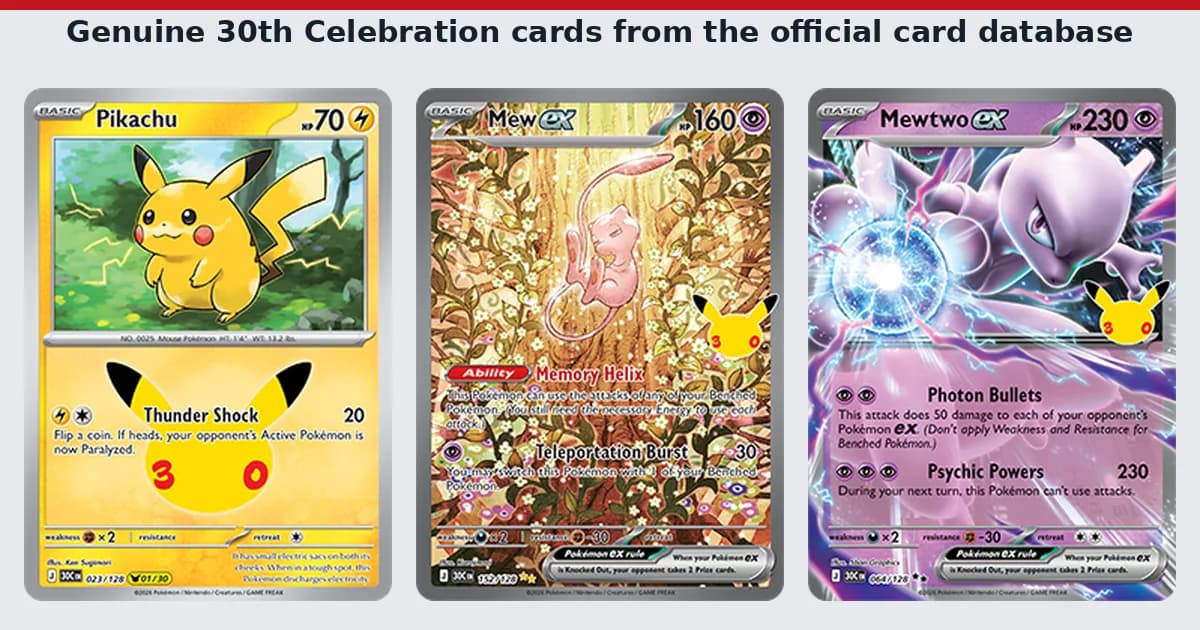
How to Spot Fake Pokemon Cards: 8 Checks That Still Work
Guides · 10 min
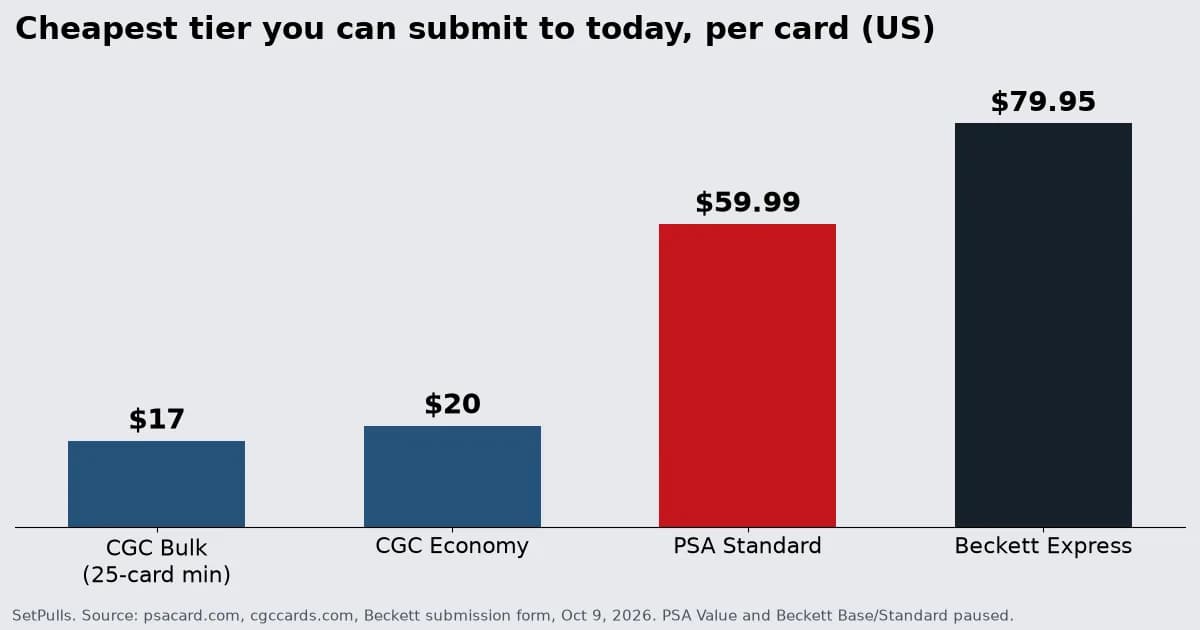
PSA vs CGC vs BGS Grading Fees 2026: Prices and Wait Times
Guides · 12 min
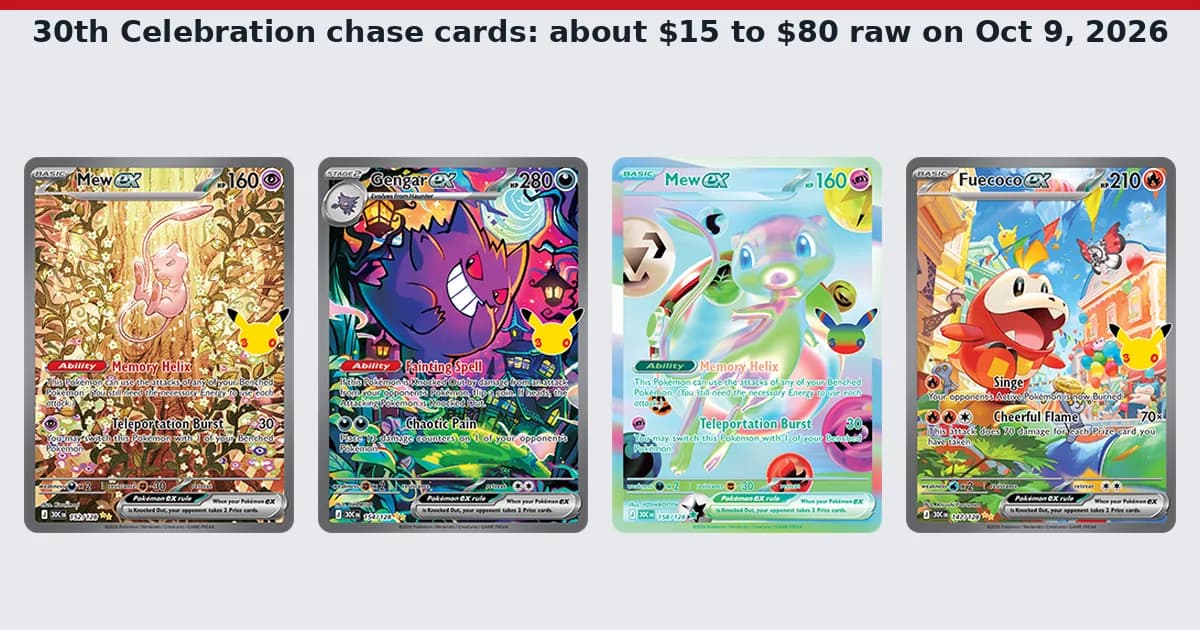
Pokemon Card Collecting Guide 2026: Condition to Grading
Guides · 14 min
Pokemon TCG Release Dates 2026-2027: Every Official Date
Guides · 10 min
30th Celebration Pull Rates: Odds From 3,000+ Packs
Guides · 12 min
30th Celebration Elite Trainer Box: 9 Packs, MSRP, Promo
Guides · 10 min
30th Celebration Card List: All 158 Cards and Top Chases
Guides · 13 min
Pokemon TCG Products Guide 2026: ETBs, Bundles, Tins, UPCs
Guides · 14 min
Disclaimer
This article is published for informational and entertainment purposes. It does not constitute professional financial, legal, or technical advice. Game performance, online services, patch schedules, and store listings change. Verify critical details (pricing, system requirements, regional availability) with publishers and storefronts before you buy. Affiliate links, where present, help support our editorial work and are labelled in our affiliate disclosure.